Growth Teardown #1: How Carrd Reached $2M ARR Without Spending a Dollar on Marketing
Carrd is a one-person SaaS that hit $2M ARR by accident. Built for one use case, discovered by audiences its creator never anticipated. Here's exactly how it happened and what solo founders can take away from it.
 Jordan Kennedy12 min read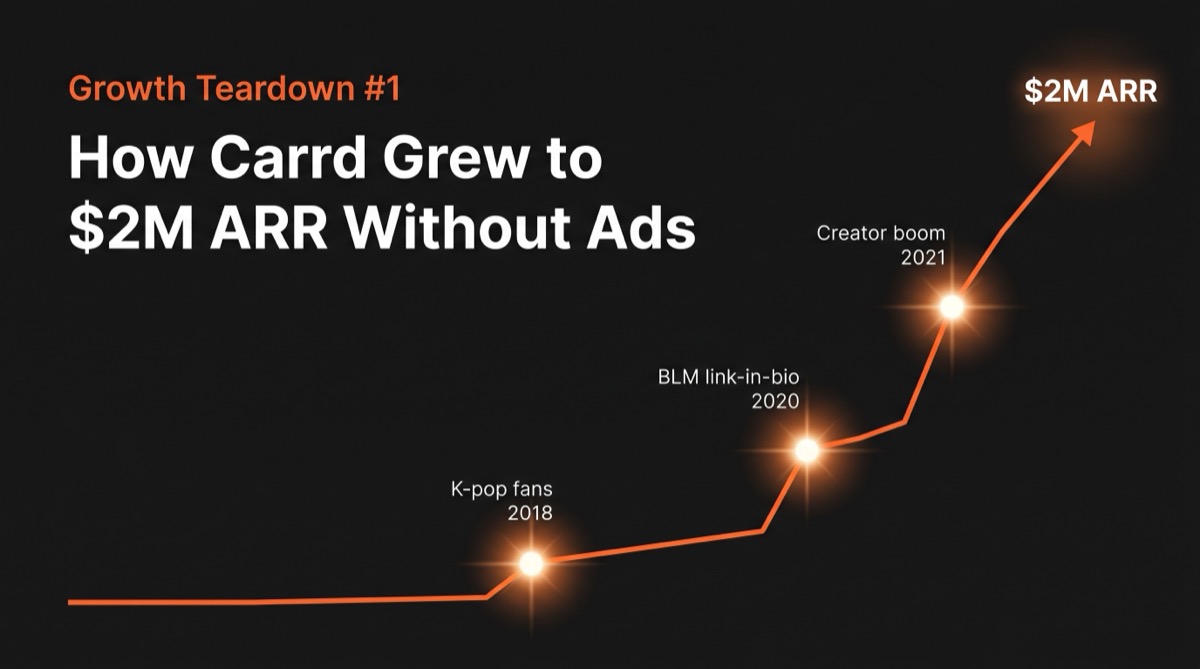
Key Takeaways
- Carrd never targeted K-pop fans, activists, or creators. All three of its biggest user waves found it on their own, which only happens when a product is genuinely frictionless.
- The free tier did more marketing work than any ad campaign could: every published Carrd site is a live billboard with 'Made with Carrd' branding seen by everyone who visits it
- AJ ran Carrd as a one-person operation through its first $1M ARR before bringing on a small team. Ruthless scope control (one-page sites only) is what made it fast enough and cheap enough to sustain as a side project.
- Carrd's $19/year price point is so low that the upgrade decision is almost automatic. Removing price friction turns conversion into a product design problem, not a sales problem.
- Every viral wave Carrd caught had the same underlying structure: a large community needed a fast, free, no-login way to publish a public page, and nothing else came close
In 2016, AJ (@ajlkn) launched Carrd as a side project. He wanted a simple way to build one-page personal sites. No landing page builder. No drag-and-drop monstrosity. Just clean, fast, single-page sites.
He did not expect to build a $2M ARR business. He did not run ads, hire a marketing team, or execute a growth strategy. What he built was so frictionless that three separate communities discovered it on their own and each drove a wave of growth he never planned for.
This is the first entry in the Growth Teardown series: a close look at how a specific indie product grew, what actually drove the numbers, and what solo founders can extract and apply to their own situation. (If you are still on day one, start with how to get your first 100 users and come back here for the long-arc playbook.)
What is Carrd, exactly?
Carrd is a website builder for single-page sites. That constraint is the entire product. You cannot build a multi-page site with it. You get one page, a set of clean templates, a drag-and-drop editor, and hosting, for free.
The free tier publishes your site at a carrd.co subdomain. The Pro tiers (starting at $9/year for Pro Lite, $19 for Pro Standard, $49 for Pro Plus) unlock custom domains, forms, third-party embeds, and analytics. No monthly fee. The most popular tier costs less per year than most SaaS tools cost per month.
AJ launched it as a solo side project and ran it as a one-person operation through its first $1M ARR before adding a small team to support continued growth. No co-founders. No outside funding. One person, one product, years of ruthless scope control before any help arrived.
That scope control is not incidental to the story. It is the foundation everything else is built on.
Why does the "Made with Carrd" footer drive growth?
Every free Carrd site has a small "Made with Carrd" footer link. This is not an accident. It is the product's primary distribution mechanism.
When a user publishes a Carrd site, every person who visits that site sees the Carrd branding. At scale (millions of published sites, each receiving their own traffic) this becomes a distribution engine that runs completely on autopilot. No ad spend. No content marketing. Just the natural traffic of users sharing their own pages.
This only works because Carrd made two specific product decisions:
First, the free tier is real. Many tools offer a free tier that is essentially unusable: feature-locked, storage-limited, export-watermarked to the point where no one would publish anything serious with it. Carrd's free tier is genuinely usable. Real people publish real sites on the free tier and share them publicly. That is the only way the branded footer becomes distribution.
Second, the product is fast. You can go from Carrd's homepage to a published site in under ten minutes. No account required to start. No credit card. No onboarding flow with five steps and a welcome email sequence. The zero-to-published friction is low enough that people who find it on a Tuesday afternoon have a live site by Tuesday evening.
Those two decisions set the stage for everything that followed.
Why did K-pop fans adopt Carrd? (Wave 1, 2018-2019)
The first unexpected growth wave came from K-pop fan communities.
K-pop fandoms operate with remarkable organizational sophistication. Fan sites coordinate streaming campaigns, track chart positions, organize birthday projects for artists, and manage donation drives for fan-funded billboards. All of this requires a lightweight public page that can be set up fast and shared within a community.
By 2018-2019, K-pop fan accounts on X (then Twitter) had started using Carrd for exactly this. The format spread within communities the way social formats always spread: one person does it, it works, others copy the format.
AJ has mentioned in interviews that he noticed the K-pop fan traffic before he understood what was driving it. Sites were being created at an unusual rate. The content was in Korean. The templates being used were consistent across thousands of accounts.
He did not build for this. He did not market to this community. They found Carrd because it was the best available tool for their specific need: a fast, free, shareable public page with no barriers to creation.
The K-pop wave established something important: Carrd's core value was not "personal portfolio site." It was "fastest way to publish a public page." That realization would prove relevant twice more.
How did Carrd become the BLM movement's link tool? (Wave 2, 2020)
In the summer of 2020, Black Lives Matter protests spread across the United States. Activists and organizers needed a way to quickly share resources: bail funds, donation links, protest schedules, reading lists, petition links.
X bios can only hold so much. A full website takes time to build and maintain. What was needed was a fast, free, single-page resource that could be created in an afternoon and shared immediately.
Carrd's signups spiked dramatically. Pages like "blacklivesmatters.carrd.co" aggregated donation links and resources and were shared hundreds of thousands of times. The format spread through activist networks the same way it had spread through K-pop communities two years earlier.
The mechanics were identical: a large, organized community needed a fast, free, frictionless way to publish a public page. Carrd was the best tool for that job. They found it on their own.
AJ later commented that the spike was unlike anything he had seen before. Servers strained. He worked to keep the infrastructure stable. The community's need was urgent enough that even a slow-loading page was better than nothing, but the fact that it held up helped Carrd's reputation within activist communities.
How did Carrd compete with Linktree in the link-in-bio era? (Wave 3, 2021)
Instagram's single-link-in-bio constraint has been a minor frustration for creators for years. As creator businesses became more complex (multiple products, affiliate links, podcast, newsletter, merchandise) the single link became increasingly inadequate.
The "link-in-bio" format emerged as a solution: a simple page that aggregates all of a creator's links in one place, designed to live in the bio field. Linktree built a dedicated product around this. Carrd was already doing it.
In 2021, as the creator economy expanded rapidly, Carrd became a legitimate alternative to Linktree for creators who wanted more design control. Carrd's templates could produce a cleaner, more on-brand link page than Linktree's more constrained interface. And at $19/year versus Linktree's freemium model, the price was not a serious objection.
Creators with audiences recommended Carrd to their followers. "Link-in-bio built with Carrd" became a visible format across Instagram and TikTok. The "Made with Carrd" footer, visible to everyone who clicked a creator's bio link, continued to do its work.
By this point, Carrd had been discovered by three completely different communities (K-pop fandoms, activists, and creators) without targeting any of them. Each wave brought new users who stayed. Each wave expanded the set of templates, use cases, and community knowledge that made Carrd more useful for the next wave.
What did AJ do right (and refuse to do) with Carrd?
It would be easy to look at Carrd's growth and conclude that luck was the dominant factor. Three separate communities happened to need exactly what Carrd offered, and they happened to show up.
That reading misses the point.
AJ built a product that was genuinely frictionless, genuinely free at the entry level, and genuinely fast. Those properties are not luck. They are the result of years of sustained product decisions: resisting scope creep, keeping hosting costs low enough that the free tier could be real, optimizing performance, keeping the editor fast. Every time AJ could have added a feature that made Carrd more powerful but slower or more expensive to run, he held the line.
The communities that drove Carrd's growth did not need a powerful website builder. They needed a fast, free, shareable page. Carrd's constraints were features for these users, not limitations.
A few other things AJ got right:
He did not kill the free tier. When a product gets popular, the temptation to tighten the free tier is strong. More conversions, more revenue, less server load. AJ kept the free tier real. The distribution engine kept running.
He stayed transparent. AJ has shared revenue milestones, product decisions, and the story of Carrd's growth publicly on X for years. That transparency built a community of indie founders and developers who rooted for Carrd's success, wrote about it, and recommended it. Free press driven by genuine goodwill.
He never panicked into complexity. When Linktree and other link-in-bio tools raised venture capital and started adding features, AJ did not try to compete feature-for-feature. Carrd stayed focused. Users who needed complexity went to other tools. Users who needed simplicity stayed with Carrd and upgraded.
What are Carrd's actual growth numbers?
AJ has shared enough on X over the years to reconstruct an approximate timeline:
| Year | Milestone |
|---|---|
| 2016 | Launched as a side project |
| 2017 | Reached approximately 10,000 registered users |
| 2018-2019 | K-pop wave; significant acceleration |
| 2020 | BLM wave; largest single growth spike |
| 2021 | Creator / link-in-bio wave; crossed $1M ARR |
| 2022-2023 | Continued compounding; small team brought on |
| 2024 | Crossed $2M ARR |
The path from $1M to $2M ARR took longer than $0 to $1M, which is unusual. Most SaaS products see compounding acceleration. For Carrd, the viral spikes were so large that the comparisons are hard. The underlying organic growth (SEO, word of mouth, referrals from published sites) has been steady and compounding throughout.
With pricing tiers at $9 (Pro Lite), $19 (Pro Standard), and $49 (Pro Plus) per year, $2M ARR works out to a paying customer base in the high tens of thousands once the mix is accounted for. The exact split is not public, but the order of magnitude is what matters.
One founder for most of the journey. No marketing budget. Tens of thousands of paying customers. The math is not complicated. The execution is.
What can solo founders learn from Carrd?
Carrd is not a template you can copy. The specific viral waves were the result of cultural moments that cannot be engineered. But the underlying conditions that allowed Carrd to catch those waves are replicable:
Build a genuine free tier with visible branding. If your product involves users creating or publishing something, that output is your distribution. Make the free tier real enough that people publish things worth sharing. Put your brand on it. Let the work do the marketing.
Constrain your scope until it hurts. The reason Carrd is fast, cheap to run, and maintainable by a tiny team (just AJ alone for the first $1M ARR) is that he refused to build a multi-page site builder, a CMS, a blog platform, or an e-commerce tool. Every time he held the line on scope, he preserved the performance and simplicity that made Carrd useful to communities with urgent, low-patience use cases.
Price for conversion, not for revenue maximization. At $19/year, the decision to upgrade is not a deliberate financial consideration for most users. It happens when someone wants a custom domain. The low price converts Carrd's hundreds of thousands of free users into paying customers without a sales process. If your product has a natural upgrade trigger, price the entry tier low enough that the trigger is the barrier, not the price.
Watch who actually uses your product. AJ did not anticipate K-pop fans. When they showed up, he noticed, he did not break the thing that was working for them, and he served them well. The communities that will drive your growth may not be the ones you originally built for. Build the product. Watch who shows up. Serve them.
Transparency compounds. Years of honest public updates on X built Carrd an audience of indie founders who genuinely wanted it to succeed. That goodwill translates into articles, recommendations, and mentions that no ad campaign can buy.
The bottom line
Carrd's $2M ARR is the result of a small number of decisions held over a long period:
- A free tier real enough that users publish things they share, with branding visible to everyone who sees those pages
- Scope so tight the product stays fast, cheap, and maintainable by one person
- Pricing low enough that the upgrade decision is not a financial deliberation
- Founder attention paid to whoever actually shows up, not to the user persona originally targeted
- Public, honest updates that compound into a reputation no ad budget can buy
Three accidental viral waves caught the product because the product was ready to be caught. That is the whole story.
If you are trying to do the same thing for your product, the first move is figuring out who would actually show up if they discovered it. That is what GrowthMap does: paste your URL, get back the competitor data, audience analysis, and outreach targets that show you which communities are most likely to be your version of the K-pop wave. If you are still on day one and need the tactical playbook for getting in front of those communities, the first 100 users guide is the right next read.
The arc of Carrd's growth is a decade-long story of patience, constraint, and a product so well-suited to a specific job that the internet found it on its own. Three times. That is not luck. That is what happens when the product is right and the founder does not get in its way.
Frequently Asked Questions
How did Carrd grow without marketing?
Carrd grew through three organic viral waves driven by communities that needed a fast, free way to publish a public page. K-pop fan sites by 2018-2019, BLM donation link pages in 2020, and creator link-in-bio pages in 2021 each drove massive spikes in signups. The 'Made with Carrd' footer on every free site meant that millions of visitors became aware of Carrd without AJ spending anything on advertising. Word of mouth within tight-knit communities did the distribution.
How much does Carrd make per year?
Carrd has publicly crossed $2M ARR. AJ, the founder, has shared revenue milestones on X over the years. With pricing tiers at $9 (Pro Lite), $19 (Pro Standard), and $49 (Pro Plus) per year, $2M ARR works out to a customer base in the high tens of thousands, an extraordinary number for a product run for most of its life by one person.
Who built Carrd?
Carrd was built by AJ (handle @ajlkn), an indie developer. He launched it in 2016 as a side project and ran it as a one-person operation through its first $1M ARR before bringing on a small team to help support continued growth. It is one of the most cited examples of how far a single founder can take a focused SaaS product before needing help.
Why did K-pop fans use Carrd?
K-pop fan communities needed a way to organize support campaigns, share resources, and link to streaming platforms, and they needed it fast, free, and without requiring a Google account or email signup. Carrd's no-login free tier, fast publishing, and clean aesthetic matched exactly what they needed. Once one fan account used it, the format spread virally within the community.
What can indie founders learn from Carrd's growth?
The main lessons are: (1) a permanent free tier with visible branding is the most efficient distribution mechanism for a publishing tool; (2) ruthless scope control lets one person maintain a product that feels polished; (3) you cannot always predict who your best users will be, so build for a use case, then watch who actually shows up and serve them well; (4) a very low annual price removes conversion friction and turns your product into something people upgrade without deliberating.