How to Get Your First 100 Users Without a Marketing Budget
The 5-playbook system solo founders use to reach their first 100 users with zero marketing budget. Scripts, a 30-day plan, and real examples included.
 Jordan Kennedy38 min read
Key Takeaways
- Most founders fail the first 100 users phase for three reasons: no research before marketing, pitching before earning trust, and trying to scale before one channel works.
- Pick the metric that matters for your product type (active users, paying customers, or retained users) before you start counting. Signups are not users.
- A 10-hour research sprint produces three documents that make every downstream tactic 3 to 5 times more effective.
- Different product types need different playbooks. B2B SaaS leads with direct outreach. Creator tools lead with community. Devtools lead with a free tool.
- Direct outreach to 20 pre-qualified prospects converts at 15 to 20 percent. Mass cold email to 2,000 unqualified prospects converts under 1 percent. Target beats volume.
- The first 100 users are personal and slow. Founders who try to skip this phase end up doing it anyway at month 12 with less information.
The hardest part of building your first product is not the product. I've watched a dozen indie founders ship something they were genuinely proud of and then wonder why nobody showed up. The product was fine. The launch post got 40 likes. Product Hunt gave them a small spike. Then nothing.
I've been that founder. Every solo founder has been that founder. You spend months on the thing, you push it live, and you realize you have no idea where your actual customers are. That's the first 100 users problem, and it's a distribution problem, not a product problem. It takes a different skill set than the one you used to build the product.
This is the playbook I use across the three products I ship (Balance Pro, Limelight, and GrowthMap), compressed into everything I've learned about getting from zero to 100 real users with no ad spend. It works. But it's slow, personal, and it requires doing a lot of things that don't scale.
Before we get to the tactics, there's a reason most founders fail at this step, and it's worth a minute to understand why.
Why do most products fail to reach their first 100 users?
Three reasons account for most of the failures I see. Most founders hit one of them, some hit all three.
They try to market before doing research. A founder builds a product, writes landing page copy that sounds right to them, ships it, and waits. The copy uses the words they would use, not the words their customers use. The positioning answers the question they think is important, not the one customers ask when they are frustrated. Every downstream tactic is running blind without the research step (competitor reviews, customer vocabulary, watering hole mapping), and blind tactics almost always fail.
They pitch before they earn trust. The classic version of this is the founder who joins a subreddit, posts "hey I just launched!" in their first week, and gets flamed or ignored. Communities can smell a pitch from 10 feet away. If your first interaction in a community is a product post, you are not going to convert anyone. Trust is earned before attention is earned, and most founders don't have the patience for the trust step.
They try to scale before one channel works. You see this when a founder simultaneously launches a newsletter, a Threads account, a Discord server, a Product Hunt page, a TikTok presence, and a cold email campaign in the same week. Nothing gets real attention. Nothing works well. The founder burns out because they are doing 12 tasks poorly. The rule that separates founders who get past 100 from founders who don't is this: pick one tactic, commit 30 days to it, measure honestly, then either double down or kill it. One channel working is worth 10 channels half-working.
If you recognized yourself in one of those three, you are not doing anything wrong. I've done all three, more than once. The point is that the fix comes before the tactics, and the tactics only work if you fix these three problems first.
What does "first 100 users" actually mean?
Before you chase the number, decide what counts. This matters more than founders think.
Signups are not users. A signup is someone who gave you an email. A user is someone who actually opened the product, did the thing, and came back. The gap between those two numbers is usually 60 to 80 percent, which means "1,000 signups" is closer to 200 actual users. When a founder tells me they have 500 users but their retention is tanking, 9 times out of 10 they are counting signups.
Here is how I pick the right metric based on what you are building:
| Product type | The metric that matters |
|---|---|
| B2B SaaS with a free trial | Paying customers. Trials inflate the number without telling you anything. |
| Freemium / free-tier product | Weekly active users. Someone who signed up and ghosted is not a user. |
| Mobile app with no pricing | Day 7 retained users. The App Store retention curve is brutal. |
| Consumer tool with a one-time action | Users who completed the core action. |
| Marketplace or community product | Active contributors, not just lurkers. |
Pick one, write it down, and defend it. The worst thing you can do pre-100 is optimize for a number that doesn't mean anything. A lot of founders realize at month six that their 2,000 signups are actually 80 weekly actives, and have to restart the counter.
One more thing. The 100 number itself is not magic. It's a useful milestone because under 100 you are still in the "one at a time" phase, and past 100 you start to see real patterns in the data. If your product is niche enough that 30 paying customers represents a healthy business, don't let a blog post tell you 100 is the target. The real milestone is "enough data to make decisions," which for most products is somewhere between 50 and 150.
What research should you do before marketing your product?

This is the step most founders skip. It's also the step with the highest leverage. Ten hours of research, done once, makes every downstream tactic 3 to 5 times more effective because you stop guessing about the language, the channels, and the objections.
You are producing three documents in this sprint. Write them down as actual files. Don't trust yourself to remember them.
Document 1: The customer vocabulary sheet
Read the 1-star and 2-star reviews of your top three competitors. App Store, Play Store, G2, Capterra, Reddit threads, anywhere customers complain in public. Read all of it, take 3 to 4 hours, and keep a running doc.
You are not looking for product ideas. You are looking for the exact phrases frustrated customers use.
| Verbatim phrase | Source | Category |
|---|---|---|
| "Takes 20 minutes to sync and I have to keep the app open" | Mint App Store review, 2 stars | Speed / friction |
| "Can't figure out why my balance is wrong" | r/personalfinance thread | Trust / accuracy |
| "I feel guilty every time I open it" | YNAB review | Emotional load |
That last column is where the gold is. When the same category (speed, trust, emotional load, onboarding friction, pricing pain) shows up across multiple competitors, you have found a positioning opportunity. Those are the phrases you put verbatim in your landing page, your outreach messages, and your cold emails. A good 1-star review is better market research than any survey, because the reviewer is emotionally activated, specific, and honest. A survey respondent has every reason to soften their answer. A person writing a 1-star review has no such incentive.
Document 2: The watering hole map
A watering hole is an online space where your customers already gather before they know your product exists. You are looking for three of them that meet two criteria: (1) real activity, and (2) real topical overlap with the problem your product solves.
How I find them:
- Search Reddit for the problem your product solves, not your product category. "How do I keep my budget on track with a variable income" is a better search than "budgeting app." Note which subreddits produce results with real comments and engagement.
- Search "[your niche] newsletter" on Google, subscribe to the top five, and look at who they interview, link to, and sponsor. Those are the other watering holes.
- Ask your first 5 users (or the first 5 people you find who have the problem): "Where do you go online to learn about [problem space]?" Their answers will be more accurate than any research you do on your own.
Map it out:
| Watering hole | Activity level | Your role | Posting cadence |
|---|---|---|---|
| r/indiehackers | High, daily | Commenter, not poster | Comment 2x/day, no links |
| Indie Hackers forum | Medium, daily | Thoughtful poster | 1 genuine post per week |
| Small SaaS founders Slack | Medium, daily | Answer questions | Daily check, help when asked |
Document 3: The competitor positioning matrix
For each of your top three to five competitors, write one sentence for each of these fields: what they are genuinely good at, where they fall short (per the reviews), who they are for, and who they are not for. Then write the same sentences for your product. Stack them.
What you are looking for is the empty cell. The use case or audience that none of the competitors serve well. That is your positioning wedge, and it's where every marketing message you write from here forward should start.
Ten hours of work, three documents, and you've separated yourself from 80 percent of founders at this stage. Now you can pick a tactic and run it with confidence.
Where do your customers actually gather online?

This deserves its own section because watering holes are the most misunderstood piece of early-stage distribution. A watering hole is not a place where your product could theoretically be relevant. It's a place where your customers are already discussing the problem your product solves, in the present tense, today.
Most founders pick the wrong watering holes. They pick the ones with the biggest audiences (r/startups, Hacker News front page, the general entrepreneurship subreddits) instead of the ones where their exact customer actually is. A "general" audience is a bad audience. 500 active members who all have the problem you solve will convert better than 500,000 members who mostly don't.
Here are the categories of watering hole that actually produce users at this stage:
Niche subreddits. Not r/startups or r/Entrepreneur. I mean the 5,000-member subreddit that exists because a specific group of people needed a place to talk about their specific problem. r/selfhosted for devtools around self-hosting. r/smallbusiness for B2B tools that hit that segment. r/Notion for Notion-adjacent products. If you can find a subreddit that is literally the name of your customer's daily activity, that's gold.
Slack and Discord communities. These are where the highest-intent customers often live, because joining one requires effort. They tend to be smaller (200 to 2,000 members) but more engaged. Indie Hackers has one. Every niche has one. Most are findable by searching "[niche] slack community" or "[niche] discord." A handful of them are invite-only, which is a filter, not a barrier. If your product is good, someone will invite you.
Newsletters with reply culture. A newsletter you reply to is different from a newsletter you read. The ones where the author responds to replies are miniature communities. Subscribing, engaging, and occasionally getting your own content shared by the author is one of the highest-leverage moves a pre-100 founder can make. Find three of these in your space.
Competitor review platforms. G2, Capterra, and app store reviews are watering holes too, just inverted. Instead of you going there to talk, you go there to listen. The patterns in the 1-star reviews tell you what your positioning should be.
Creator spaces. If you are building anything creator-adjacent, Product Hunt is less useful than you think and Threads is more useful than you think, but the real watering holes are spaces like creator-specific Discords, niche YouTube comment sections, and the replies under creator Threads accounts.
Once you have three watering holes, spend 20 minutes a day for two weeks doing nothing but being helpful. Answer questions. Share what you've learned. Do not link to your product. People will click your profile, see what you are building, and a small number will reach out. That small number is more valuable than a large number of people who clicked an ad, because they found you through something you did well, not through a cold interruption.
Which user acquisition playbook should you pick for your product?

This is the part of first-100-users advice that most articles get wrong. They tell you to do everything. In practice, different product types need to lead with different playbooks, and trying to run all five at once pre-100 is how founders burn out.
Here is the matrix I use. Pick the row that matches your product, then run the "lead with" playbook for the first 30 days. Add the second playbook in week five or six, and only if the first one is working.
| Product type | Lead with | Add second | Real example |
|---|---|---|---|
| B2B SaaS (clear buyer, clear budget) | Direct outreach | Useful article | ConvertKit (now Kit) did direct outreach to bloggers |
| Devtool / technical product | Free tool + content | Community | Plausible grew through comparison posts and open source |
| Creator / prosumer tool | Community participation | Launch moment | Obsidian grew through r/Obsidian and Discord |
| Consumer app (visual, viral potential) | Free tier + branding | Launch moment | Carrd grew through free sites with "Made with Carrd" |
| Horizontal SaaS (no clear buyer) | Useful article (SEO) | Community | Plausible grew on comparison content |
| Niche marketplace | Direct outreach to supply | Content | Superhuman built the list manually for months |
A note on each of those: I'll walk through the five playbooks below in the order that matches most solo founder products. If you are building something that doesn't fit neatly in this matrix, the tiebreaker question is "who is my exact customer, and where are they right now?" The answer tells you which playbook to lead with.
Playbook 1: Direct outreach to pre-qualified prospects
Cold outreach has a bad reputation because most people do it badly. They send generic messages to unqualified lists. The version that actually works looks almost nothing like mass cold email.
You identify 20 specific people who have the exact problem your product solves, and who have demonstrated that they have it in a place you can see. You then send each of them a short, personal, specific message that references the thing they actually said. Twenty messages typically produces 3 to 5 real conversations at a 15 to 20 percent reply rate, and most of those conversations become users.
Where to find pre-qualified individuals:
- People who posted a question in your watering hole subreddits that your product would answer
- People who followed a competitor on Threads and publicly complained about them
- People who left a 2-star review on a competitor explaining exactly why they were frustrated
- People who commented on relevant articles with phrases like "I wish there was a tool that..."
- People who posted on Indie Hackers or a niche forum about trying to solve the problem manually
The message has four parts. Hook (reference the specific thing they posted or said, in their own words). Evidence that you actually read it (a detail that proves you are not copy-pasting). Specific ask (usually a 15-minute call, sometimes a link to try the product). Out-clause (make it easy to say no without guilt).
A template that works well, with the hook adapted to the source:
Hi [Name],

I saw your post in r/[subreddit] about [specific problem from their actual post,
quoted in their own words if possible]. The part about [a specific detail they
mentioned] hit home.

I'm building [one sentence product description], and I'm trying to understand
how people are solving [the specific problem] today before I get too deep. Would
you be up for a 15-minute call this week? If it's easier, I can just send you a
link to try what I've built and you can tell me where it falls short.

Totally fine if not, I know how annoying cold messages are.

[Name]
Three reasons this works:
-
The reference line has to be specific. "I saw your post" is generic. "I saw your post about how your team spent two days reconciling the March close" is specific. The specificity signals that you actually read their thing, which flips the dynamic from "you are pitching me" to "you noticed me."
-
The ask is small. Fifteen minutes is the ask that gets accepted. Thirty minutes is the ask that gets ignored. "Try my product" is actually a larger ask than "hop on a call," because trying a product takes effort and attention. A call is passive for them.
-
The out-clause is real. "Totally fine if not" has to mean it. If you follow up five times, you burn the relationship. Follow up once, 7 to 10 days later, then stop.
A note on scale: this playbook works until about 50 to 100 users, then it stops being the highest-leverage move. The shift happens when your product has enough users that you can drive growth through actions other people take (referrals, content that ranks, community recommendations). Before that point, one personal conversation beats 100 impressions.
Playbook 2: Community participation that compounds
This is the playbook that turns your watering hole map into actual users. It works especially well for creator tools, consumer products, and anything with a passionate niche audience. It's slower than direct outreach but the compounding is higher, because reputation in a community is an asset that keeps producing users for years.
The rule I use is 30:1. Thirty genuine, helpful contributions before one product mention. Most founders have this ratio inverted, which is why most community participation fails.
Here is what a day looks like in a watering hole, at 20 minutes a day:
- 5 minutes scanning the new posts in your three spaces
- 10 minutes writing one thoughtful comment that actually answers a question (not a promoted answer, a real answer, with specifics)
- 5 minutes responding to replies to your earlier comments
You are trying to become the person who reliably shows up with useful information. Not the most frequent poster. The most helpful one. Most communities have a few regulars who get a disproportionate amount of attention and trust, and you can become one of those regulars in 30 to 60 days of consistent participation.
Three habits that separate real participation from fake participation:
Your answers include specifics. "Try Stripe" is not useful. "We moved from Stripe to Paddle because of VAT handling in the EU, but Stripe was better for recurring subscription UX" is useful. Specificity is the difference.
You acknowledge when you don't know. "I don't have experience with that, but here is who I would ask" is more trust-building than a confident wrong answer.
You don't link to your product in your answers. People will look at your profile. People will see what you are building. If your product is genuinely relevant to someone's question, they will find it. You do not need to volunteer it. This is the single hardest thing about community participation for founders who are impatient.
After 30 to 60 days of this, you have earned the right to occasionally post about what you are building, and those posts will actually get read. A "launch" post in a community where you have a track record will outperform a launch post from a stranger by 10x.
Obsidian is the canonical example. The core community built up in r/ObsidianMD and the official Discord was so strong that new users onboarded themselves by watching existing users. No marketing team, no ad budget, no paid acquisition. Just a product that resonated and a founder team that participated in the community honestly.
Playbook 3: The one genuinely useful article
This playbook works best for products with existing search demand. If people are already Googling the problem your product solves, writing one article that ranks for a version of that query is one of the highest-leverage moves a solo founder can make. Not because it will drive thousands of users in month one, but because it will drive compounding traffic for years.
The criteria for the article:
- It solves one specific problem for one specific person, not the general category
- It is written for a reader who has never heard of you
- It is long enough to be useful (I aim for 1,500 to 3,000 words)
- It is honest about what doesn't work, not just what does
- It does not pitch your product until the final paragraphs, and even then only lightly
The format that performs best at this stage, for solo founders, is "How I [specific outcome] using [specific method]." It performs well because it is specific (which gives it a shot at ranking for long-tail queries), it is experiential (which builds credibility), and it is shareable (people send posts like this to each other because the specificity makes it useful).
The example worth studying is Plausible Analytics. Plausible grew through comparison posts ("Plausible vs Google Analytics," "Plausible vs Fathom") that ranked because each article solved a specific "which one should I use" query for a specific reader. The posts earned their rankings by being honest about tradeoffs rather than positioning the product as strictly better, which is a move most founders are too defensive to make.
Once the article is written, post it in your three watering holes. Frame it as a contribution, not a promotion. "I wrote up how I approached this problem last month. Thought it might be useful here." Most of your week-one traffic will come from these community shares. The search traffic builds over the following three to six months, compounding as the article accumulates links and dwell time.
Playbook 4: The free tool as distribution engine
This is the playbook I most consistently see solo founders underestimate. A small, focused, genuinely useful free tool generates qualified traffic indefinitely and acts as a filter for your paid product's audience. It's not a marketing gimmick. It's a piece of software that happens to pay you back in leads.
The criteria for a good free tool:
- It solves a sub-problem for your audience (not the whole problem, just a piece of it)
- It works without signup (signup walls kill the virality)
- It takes a weekend to build, not a month
- It naturally attracts the same person who would benefit from your paid product
Examples that work:
- A calculator that saves 20 minutes of manual math
- A checklist that helps someone audit their current approach
- A template that removes the blank-page problem
- A quiz that helps someone identify where they stand
- A simple interactive tool that answers a decision they are trying to make
I built the Marketing Channel Prioritizer as this kind of tool for GrowthMap. It takes a product description, gives you a ranked list of which marketing channels to prioritize, and takes 30 seconds. No signup, no email gate. It exists because the audience for the main product (solo founders deciding where to spend their limited time) is the exact audience that benefits from a free version of that decision-making. The tool does the filtering for me.
Free tools work for a specific reason that took me a while to understand. They rank for long-tail search queries that transactional pages never rank for, because people searching for a tool to help them do X are different from people searching for a product to help them do X. They also get shared because the barrier to sharing is low ("here, this will help"), which creates a referral loop for free.
The tradeoff is the build time. A free tool is a real piece of software, not a PDF lead magnet. If you can commit a weekend to it, do it. If not, the other four playbooks will likely produce results faster.
Playbook 5: The launch moment (and what actually happens)
Product Hunt, Hacker News, and Reddit launches are the most overrated part of the first-100-users phase. They look important because they are visible, but they produce a tiny fraction of retained users compared to the playbooks above. I am not saying don't do them. I am saying don't build your strategy around them.
Here is what actually happens on each:
Product Hunt. A top-10 finish produces 500 to 2,000 visitors on launch day. Most don't sign up. Of the ones who do, most don't come back. The real value of Product Hunt is the permanent page on a high-authority domain, which helps SEO long after the launch, and the small list of people who become meaningful supporters. Optimize for the meaningful 20, not the passing 2,000.
Hacker News. A front page post (Show HN or blog post) produces 3,000 to 30,000 visitors on the day. Hacker News traffic is technical and unforgiving. Most will not sign up. A small percentage will, and of those, the conversion to paid is higher than any other traffic source because the audience is engineering-oriented and high-intent. If you are building a devtool, HN is your best single-day shot. If you are not, the audience mismatch hurts.
Reddit. A good post in the right niche subreddit can produce as much qualified traffic as a front-page Hacker News post, and it lasts longer because Reddit posts surface on Google for months. The trick is that you have to be a member of the community first, or the mods will remove the post.
A launch playbook that actually works:
- Don't launch until you have the first four playbooks producing some results. Launching cold is a waste.
- Pick one venue, not three. Fragmented attention dilutes every venue.
- Build the asset first. A launch with no demo video, no landing page polish, and no social proof performs 3 to 5 times worse than a launch with those pieces in place.
- Plan the day. The top comments on a PH post in the first hour determine the momentum. Have a group of 10 to 20 people who will actually use and comment on the product on launch day.
- Follow up. Everyone who signed up on launch day gets a personal email in week two. This is where launch spikes turn into retained users.
Loom's early growth came from a well-executed Product Hunt launch in 2016 that produced a few thousand signups. Those signups became advocates because the demo video was so clear about the core use case. The launch didn't make the product. The product made the launch work, and the launch accelerated what was already starting.
How to do cold outreach that gets 15 to 20 percent reply rates
This is a section worth its own deep dive because cold outreach, done correctly, is the single highest-conversion tactic pre-100, and done badly it's a waste of everyone's time.
The four factors that separate 15 percent reply rates from 1 percent reply rates:
Pre-qualification. A list of 20 specific people you can describe in one sentence each (who they are, what they posted, why your product is relevant) will convert dramatically better than a list of 2,000 people who fit a job title filter. Spend an hour researching each person before you write their message. Yes, this is slow. That's the point.
Personalization that isn't fake. Most sales tools promise "personalization at scale," which is code for "we add their first name to a generic message." That is worse than no personalization because it signals effort without delivering it. Real personalization means the second sentence references something specific to them, in their words, that nobody else could receive.
Timing relative to their post. Reach out within 48 hours of them publicly describing the problem. The psychological window where they are actively thinking about it is short. A month later, the pain has faded and they've moved on.
Follow up exactly once. Seven to 10 days after the first message. Same thread. Single sentence: "Hi [name], just bumping this up in case it got buried. Happy to drop it if the timing's off." If they don't respond to that, stop.
Three template structures for three different product types. The structure is always the same (hook, evidence, ask, out). The details shift based on the audience.
B2B SaaS (targeting someone who posted a question on a forum):
Hi [Name],

I saw your question on [forum] about [specific problem]. The part about
[specific detail] is interesting because I'm running into something similar at
[your company or context].

I'm building [one-sentence description], and I'd love to understand how you
are handling it today. Would you be up for a 15-minute call this week? I'll
share what I've seen across the handful of people I've talked to.

Totally fine if not.

[Name]
Creator tool (targeting someone who publicly complained about a competitor):
Hi [Name],

Saw your post about [competitor] and [specific complaint]. That exact issue is
the reason I started building [your product].

I'm not ready to pitch it, but if you are open to 15 minutes to tell me what
would actually solve your problem, I'd be grateful. I can also just send you a
link and let you poke at it, whatever is easier.

No worries if not.

[Name]
Devtool (targeting someone who starred a related repo or commented on an issue):
Hi [Name],

Noticed you filed an issue on [repo] about [specific thing]. I've been thinking
about that same problem from a different angle, and I've built [one-sentence
description] to try to solve it.

Repo is here: [link]. Would love a brutal technical review if you have 10
minutes, or a 15-minute call if you'd rather talk through it.

Appreciate either way.

[Name]
Notice what's missing from all three: the word "opportunity," "synergy," "leverage," or "game-changer." Notice also that none of them pitch the product until the ask. The tone is the tone of a peer reaching out, not a seller reaching out.
What does a 30-day first-100 plan look like?
Here's the plan I run for a new product, based on which playbook is leading. Most solo founder products fit the "B2B SaaS or devtool" column. If yours fits the consumer column better, use that one.
Plan A: B2B SaaS / devtool lead
| Week | Focus | Activities | Hours |
|---|---|---|---|
| 1 | Research sprint | Competitor review mining. Build customer vocabulary sheet. Identify and join 3 watering holes. | 8 to 10 |
| 2 | Outreach start + community lurk | Build list of 20 pre-qualified prospects. Send first 10 outreach messages. Begin 20-min daily community participation. Draft article outline. | 6 to 8 |
| 3 | Scale outreach + publish | Send second batch of 10 messages. Follow up on week 2. Publish article, share in 3 watering holes. Take first user calls. | 6 to 8 |
| 4 | Free tool + review | Build weekend free tool (or start it). Post in communities. Review what's working. Decide which playbook to double down on in month two. | 8 to 10 |
Plan B: Creator tool / consumer product lead
| Week | Focus | Activities | Hours |
|---|---|---|---|
| 1 | Research sprint | Competitor review mining. Customer vocabulary sheet. Map 3 watering holes with high activity. | 8 to 10 |
| 2 | Community participation | Begin 30-minute daily helpful participation in all 3 watering holes. No product mentions. Draft article. | 5 to 7 |
| 3 | Amplify + first launch | Publish article. Post in communities as genuine contribution. Soft-launch to any existing audience you have. Start collecting feedback. | 6 to 8 |
| 4 | Launch moment | Execute Product Hunt or Reddit launch. Follow up personally with everyone who signs up. Decide on month two focus. | 10 to 12 |
Do not try to run both plans at once. Pick the one that matches your product. Most founders who fail pre-100 do so because they try to run every playbook at 30 percent intensity instead of one at 100 percent.
What scripts and templates work for early user acquisition?
This section exists because the hardest part of any of these playbooks is staring at a blank page. Here are the templates I actually use.
Watering hole contribution template (20-minute daily post):
[Answer the question directly in the first sentence.]

[Give specific, concrete detail from your own experience. Name names if
possible: products, numbers, tools.]

[If relevant, note the tradeoff or the thing you'd do differently next time.]

[If someone is likely to ask a follow-up, preempt it.]
Notice the absence of product links, "DM me if you want to chat," or any other self-promotion. The answer is the content. Your profile does the introduction.
Free tool landing page headline template:
[Exact task they want done] in [short time estimate], free and no signup.

[One-sentence explanation of what the tool does.]

[Single CTA button: "Start" or the verb of the action, not "Learn more."]
Launch post template (Indie Hackers / Reddit / Product Hunt):
I built [product] because [specific personal problem you hit].

What it does: [one sentence, concrete].

What it doesn't do: [one sentence, honest about limitations].

Stack: [tools / frameworks you used, if relevant to the community].

Would love feedback, especially on [specific question or area you're
uncertain about].

Link: [your product or free tier].
The honesty about limitations is doing more work than founders realize. A launch post that reads "it does X, Y, and Z, and it is fast and beautiful" reads like advertising. A launch post that reads "it does X and Y but Z is rough right now, would love eyes on it" reads like a real person, and real people get more upvotes than advertisers.
Follow-up email to every signup in the first 100:
Hi [Name],

I noticed you signed up for [product] [X days ago]. I'm the founder, and since
you are in the first 100 people to try this, I wanted to say hi personally.

One quick question: what made you sign up, and what are you hoping to
accomplish with it? I'm using every response to figure out where the product
is clear and where it's confusing.

No pressure, no follow-up if you don't reply. Just trying to learn from the
earliest users directly.

[Name]
Superhuman ran a version of this for years. Every early user got a personal onboarding from the founder. That ritual produced some of the most loyal early advocates the product had, and it's the reason the word-of-mouth loop worked as well as it did.
How do you know your tactics are working before you hit 100?
The 100-user number is a lagging indicator. You need leading indicators so you can course-correct before you've burned 90 days on something that isn't working.
Here is the leading-indicator dashboard I use:
| Indicator | What it tells you | Target in week 4 |
|---|---|---|
| Outreach reply rate | Is your message and targeting working? | 10% or higher |
| Community post engagement | Is your voice resonating in the watering hole? | 5+ upvotes per contribution |
| Direct traffic (not search, not referral) | Is word of mouth starting? | 20% of total traffic |
| Branded search volume | Are people looking you up by name? | Non-zero and growing |
| Unprompted DMs or emails | Are people finding you without being pushed? | 1+ per week |
| Signup-to-active conversion | Is the product actually landing with the people who try it? | 30% or higher |
If two or more of these are under target at week four, you have a signal. Usually it's one of three problems: wrong audience (your outreach list isn't pre-qualified), wrong message (your positioning is off), or wrong channel (your watering holes aren't actually where your customers are). Those three problems have three different fixes, and the next section covers them.
If all of these are on or above target, you are probably going to hit 100 users within 60 to 90 days. The math works out. Keep doing what you're doing and don't get distracted.
What should you do when nothing is working?
Here is the diagnostic flow I run when a founder tells me their first-100 plan is stalling.
Question 1: Are you getting replies to outreach at all?
- If no, the list is probably unqualified. Go back to the watering hole research and make sure each person on the list has actually demonstrated the problem, recently, in a public place. A list based on job titles or industries alone won't work.
- If yes but conversion to users is under 10 percent, the message is probably off. Try a different hook, a smaller ask, or a different out-clause.
Question 2: Is your community participation getting engagement?
- If your comments and posts are getting zero upvotes or replies, one of two problems is at play. Either the watering hole isn't as active as you thought, or your contributions aren't valuable yet. The fix for the first is finding a different watering hole. The fix for the second is more specificity.
- If you are getting engagement but no traffic to your product, the community probably isn't where your customers are. Plenty of engineers hang out in technical subreddits without being the buyers for B2B SaaS. Check the audience fit.
Question 3: Did your article get any traction?
- If it got zero shares and zero traffic, the topic was probably too generic. Rewrite with a sharper, more specific angle, or pick a different topic entirely.
- If it got traction but the traffic didn't convert, the article is probably too far from the product. The fix is adding a clearer bridge from the article to the relevant part of your product.
Question 4: What does your free tool conversion look like?
- If usage is high but email captures or signups are low, your funnel is leaking. Add a soft lead capture after the value has been delivered, not before.
- If usage is low, the tool itself probably needs a better landing page headline or a different distribution strategy.
Question 5 (the hard one): Are you sure this product is solving a real problem?
The uncomfortable truth is that sometimes the playbook isn't the problem. Sometimes the product is solving a problem people don't have, or don't have urgently enough to pay for. If all four diagnostic questions above come back clean but you still can't hit 100, it's time to do 10 customer interviews, unstructured, with people who match your target customer. Ask them what they are struggling with, not whether they'd use your product. The answers will tell you whether you are building the right thing.
This is the question nobody wants to ask themselves. I've had to ask it twice across my three products, and both times the answer required changing the product, not the marketing.
Which tactics should you avoid pre-100 (even though they feel productive)?
A list of moves I've seen founders make pre-100 that felt productive in the moment and turned out to set them back.
Buying email lists. Turns into a spam report at best, a blacklisted domain at worst. A list of 2,000 emails costs you more than a list of 20 you built yourself.
Fake urgency. "Only 10 spots left" on a $19 tool that nobody has pre-ordered reads as sad, not urgent. Real scarcity works. Manufactured scarcity destroys trust.
Referral programs before critical mass. Giving your 20 users a $10 credit for referring friends is not a growth loop. It is a tax. Referral programs start to work somewhere around 500 to 1,000 active users, when there is enough density to produce actual referrals.
Build in public with no audience. Posting your daily progress to Threads when you have 50 followers does nothing. Build in public works when it's a content asset for an existing audience, or when the building itself is genuinely interesting. If neither is true, the hours are better spent on the five playbooks.
Growth hacks that burn trust. LinkedIn automation, comment spamming, fake reviews, buying upvotes. Every one of these produces a short-term spike and a long-term cost. The community remembers.
Shipping daily as a strategy. Shipping daily is fine. Shipping daily as the strategy, without doing any of the research or distribution work, is how you build a product nobody wants faster.
Launching before you're ready. I know, I know, "ship fast." A launch without the research, the community, the article, or the outreach list in place produces a spike that dissipates in three days. You cannot relaunch easily. Don't spend your launch moment before you have the assets to convert it.
Running ads pre-100. Paid acquisition before you know what message converts is how founders burn $2,000 to learn what they could have learned in 20 cold outreach conversations. Ads work post-100, not pre.
What changes when you get to your first 100 users?
A few shifts happen all at once, and the founders who adapt the fastest get to 1,000 users fastest.
Retention becomes the primary metric. You now have enough users to see retention patterns. A leaky bucket at 100 users is a fatal one at 1,000. The month after you hit 100 should be about looking at cohort retention, churn reasons, and week-two activation, not about more top-of-funnel work.
Patterns in your users become visible. You can answer questions like "what is the common trait of my power users," "what use case are we winning," and "where is the product falling short." Those answers shape both the product roadmap and the positioning.
The one-channel rule relaxes. You earned the right to test a second channel because the first one is producing enough data to be clear on what's working. But don't add a third until the second is also producing real results.
Word of mouth starts to do visible work. Direct traffic climbs. Branded search climbs. You see the first "my friend told me about you" signups. These are the signals that you've crossed the line from push to pull.
The research documents need refreshing. Your customer vocabulary sheet, watering hole map, and positioning matrix should all be updated based on what you've learned from the first 100 conversations. A lot of what you assumed at week one will turn out to be partially wrong.
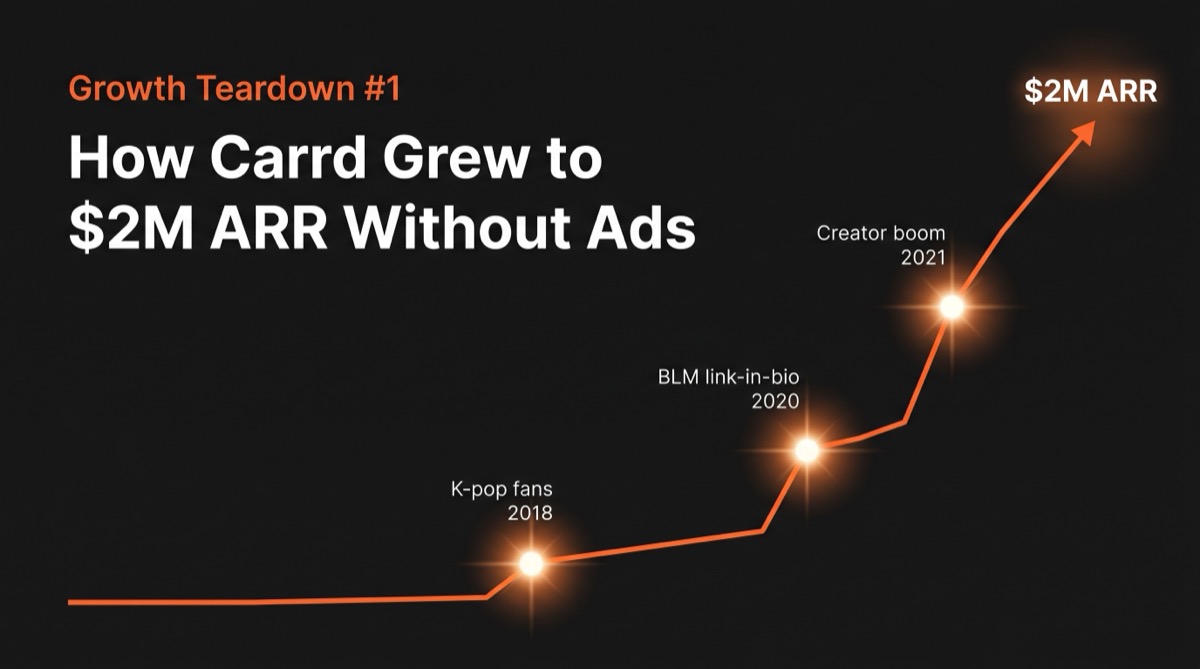
Carrd is the best long-arc example of this. How Carrd reached $2M ARR without spending a dollar on marketing is the story of what happens when you get the first 100 right and then let the compounding do the work. AJ (the solo founder behind Carrd) didn't scale through ad spend. He scaled through a free tier that acted as a distribution engine, a product so focused that users kept building one-pagers with it and showing them off, and a ruthless commitment to one use case. The first 100 users are where that trajectory starts.
Why the first 100 users are personal, slow, and worth it
The hard truth about getting your first 100 users is that it is personal and slow. You are building relationships one at a time, earning credibility in communities, and creating resources that earn trust before you ask for anything. That is what works. Founders who skip this phase and jump straight to paid ads or viral tactics almost always discover the hard way that distribution has to be earned before it can be automated.
If you want a shortcut, I don't have one. I wish I did. Every solo founder I know who broke through 100 users did some version of the work described above. Some did it faster, some slower, but nobody skipped it.
I built GrowthMap because I wanted the research sprint to take 10 minutes instead of 10 hours. You paste your product URL, we analyze your real competitors and their reviews, we map the actual communities and newsletters and podcasts in your space, and we return the 45-day action plan that would have taken you a weekend to assemble manually. It's not a replacement for the personal work. Nothing is. But it compresses the setup so you can spend your time on the tactics, not on the research.
Do the slow work first. The scale comes after.
Frequently Asked Questions
How long does it take to get your first 100 users?
Most solo founders reach 100 real users in 30 to 90 days with consistent effort. The 30-day plan in this guide focuses on competitor review mining, community participation, direct outreach, and one free tool. Expect 2 to 4 hours per week. Ten or more hours weekly compresses the timeline.
Do you need a marketing budget to get your first 100 users?
No. The five playbooks in this guide are free. Mining reviews, community participation, writing one useful article, direct outreach, and a simple free tool require time but zero money. Paid ads are less effective pre-100 because you are spending money before you know what message converts.
What is the single most effective tactic for getting first users?
Direct outreach to individuals who have publicly demonstrated the problem you solve is the highest-converting tactic at the zero-to-100 stage. A list of 20 specific people with a personalized message typically converts at 15 to 20 percent, compared to under 1 percent for mass outreach.
Where do indie founders find their first users?
The four reliable sources are: online communities where the target problem is discussed, competitor review platforms like G2 and Capterra, niche newsletters and podcasts, and direct outreach to people who have posted about the problem online. Product Hunt and Hacker News can spike signups but rarely sustain growth alone.
What is a watering hole in the context of user acquisition?
A watering hole is an online space where your target customers already gather. A subreddit, Slack group, Discord server, newsletter, or forum. Finding 2 to 3 watering holes and becoming genuinely helpful there without promoting your product is one of the most reliable ways to build early awareness and trust.
Product Hunt or Hacker News, which is better for first users?
Neither, on its own. Both can produce a single-day spike of a few hundred to a few thousand visitors, but that traffic rarely converts into retained users without the research and community work already in place. Use launch days to amplify an existing playbook, not as your primary distribution strategy.
Should you charge from day 1 or launch free?
Charge from day 1 if you are solving a B2B problem where the buyer has budget. Offering something free conditions customers to expect free. Launch free with a paid tier if your product has network effects, a viral loop, or benefits from mass adoption. The decision should be based on buyer intent, not on a default.