5 Free Ways to Find Where Your Customers Hang Out
Most founders assume where their customers are rather than finding out. Five free methods — Reddit search, SparkToro, newsletter discovery, user surveys, and competitor review mining — to locate them exactly.
 Jordan Kennedy11 min read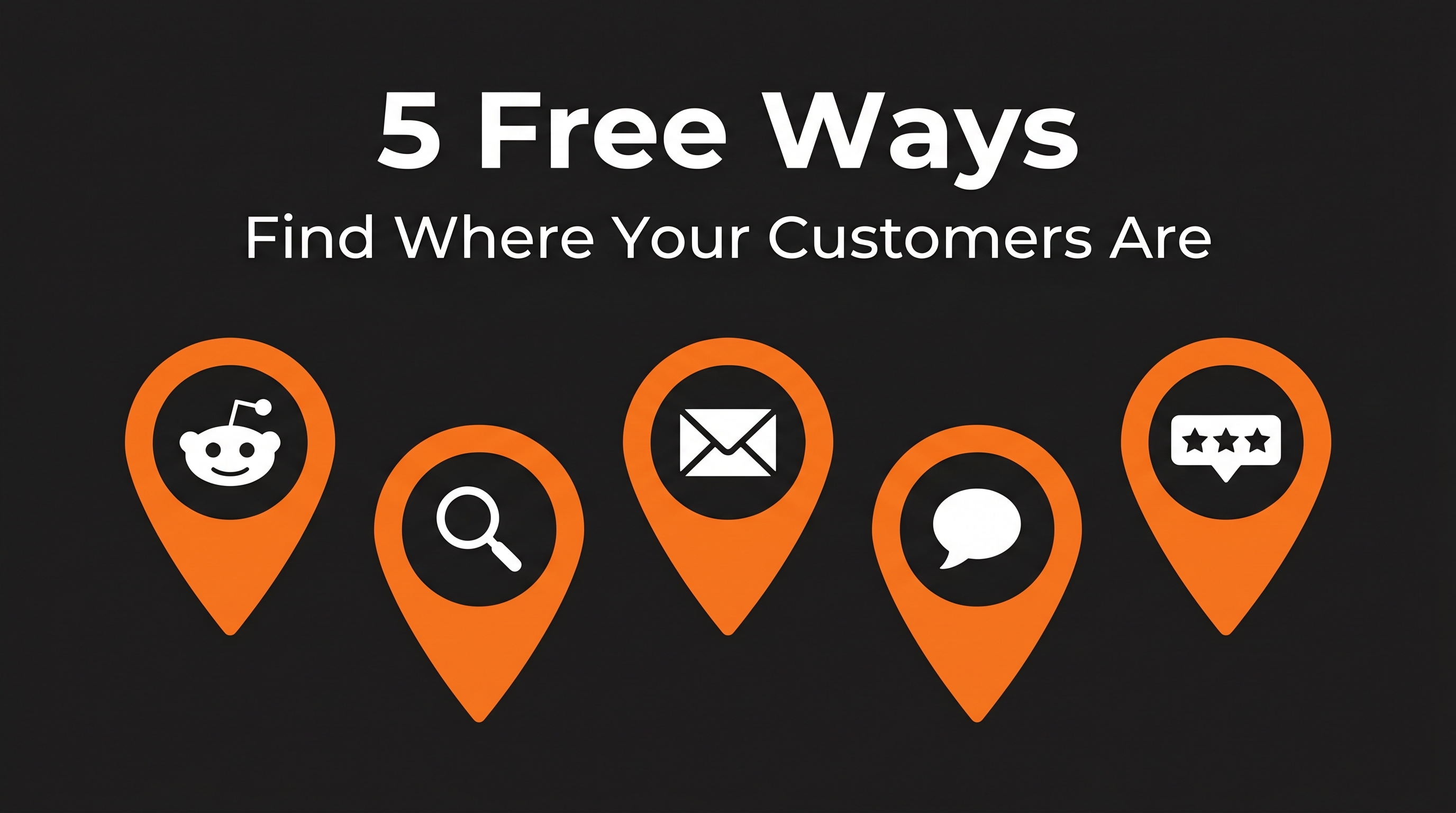
Key Takeaways
- Most founders waste months posting in the wrong channels because they assumed where customers would be rather than verifying it. Each of these five methods takes hours, not weeks, and costs nothing.
- Reddit is the best free customer discovery tool most founders never use systematically. Searching Google scoped to site:reddit.com reveals the exact communities, questions, and frustrations your customers are already expressing publicly.
- SparkToro's free tier gives you five searches per month. Each one reveals which specific newsletters, podcasts, YouTube channels, and social accounts your target audience actually follows — far more useful than demographic data.
- Competitor review mining is reverse-engineered customer research. Every detailed negative review your competitor has received describes an unmet need and identifies someone actively looking for a better solution.
- A two-question survey sent to your first ten customers produces better channel data than any tool. Ask what they were trying to accomplish and where they found you. The answers will surprise you.
Most founders I talk to have a version of the same problem: they're posting regularly, they're showing up, and nothing is converting. When I dig into where they're actually spending time, it's almost always Product Hunt, the general startup subreddits, and whatever social platform they personally use. Those places feel productive. They're full of people who understand what you're building and can give you feedback on it.
The problem is that those people are mostly other builders. Your customers are somewhere else entirely, in communities organized around the problem your product solves, not around the tools that solve it. They're in the subreddit for personal finance, not the one for fintech startups. They're reading the newsletter about productivity, not following the founder who built the productivity app.
The fix isn't a $200/month tool. It's five methods you can run in a single weekend, each one free, each one pointing you toward the specific communities, publications, and people where your customers are already gathering.
Can Reddit's own search actually find your customers?
It can't, and that's the trap. Reddit's built-in search is notoriously bad at surfacing relevant results. It buries older posts, struggles with phrase matching, and has no way to filter by the quality or depth of a thread. If you've tried searching Reddit directly for your topic and felt like you were getting noise, you were right.
The workaround is Google. Searching site:reddit.com [your topic or problem] uses Google's indexing of Reddit's content, which is far more comprehensive and accurate. The results show you which subreddits come up repeatedly for your topic, which threads generated the most engagement, and what specific language people use when they're frustrated with the problem you solve.
Here's what a deliberate search flow looks like. Start with the problem, not the product category. If you built a budgeting app for freelancers, don't search site:reddit.com budgeting app. Instead, search site:reddit.com inconsistent income budgeting or site:reddit.com how to budget when you don't know what you'll make. Those searches surface the actual conversations happening among people who have the problem. Add after:2024-01-01 to the Google query to filter for recent threads.
Once you have results, note which subreddits appear most often. If r/freelance, r/personalfinance, and r/digitalnomad keep showing up, those are your communities. Then go deeper: read the threads that have the most comments, look at what specific frustrations get upvoted, and save the exact phrases people use to describe their pain. Those phrases are your copywriting.
One more move: search for your competitor's name on Reddit. site:reddit.com [CompetitorName] problems or site:reddit.com [CompetitorName] alternative surfaces threads where people are actively unhappy with an existing solution and looking for something better. That is as warm a lead pool as you'll find outside of direct referrals.
What does SparkToro's free tier actually tell you?
SparkToro is an audience research tool built by Rand Fishkin. The paid plans are expensive, but the free tier gives you five searches per month, and five deliberate searches produce a meaningful research output.
What SparkToro shows you: for any audience you define, it surfaces the publications, podcasts, YouTube channels, social accounts, and websites that audience actually follows. Not "people who might be interested in productivity probably read this." The data is pulled from millions of social profiles and web behaviors. It's more grounded than demographic guesses.
The key is using your five searches on inputs that are highly specific. Searching for a broad topic like "productivity" wastes a search. Instead, search for your competitor's domain (e.g., toshl.com) or a specific phrase your audience cares about (e.g., "freelance income tracking"). Those searches produce lists of the exact publications and communities that audience reads, listens to, and watches.
Here's how I use the free tier without burning searches. I keep a short list of the five most specific inputs I want to research before I log in. Each search gets its own tab. I export or screenshot the results immediately, because you can't easily go back to a free-tier result without spending another search. The outputs become my outreach list: the newsletters I want to pitch, the podcasts I want to appear on, and the YouTube channels I want to engage with.
If you've already used your five searches this month, treat the SparkToro results you have as a foundation and expand from them manually. For each newsletter in the output, check who else advertises in it (competitors' ads in a newsletter confirm the audience match), and look at the newsletter's Twitter followers to find related publications in the same space.
How do you find newsletters in your niche without paying for a directory?
Newsletter discovery is one of the more underrated forms of audience research, and most of it can be done for free with a few different tools working in combination.
Start with Substack's explore page at substack.com/explore. Search for your topic and filter by subscriber count or growth rate. The results show you which newsletters exist at the intersection of your topic and your audience. Read a few issues before you pitch anyone: subject matter fit is obvious in ten minutes of reading.
beehiiv Discover (beehiiv.com/discover) indexes newsletters built on the beehiiv platform and lets you browse by category. Many fast-growing independent newsletters are on beehiiv now, so this covers a meaningful slice of the market that Substack search misses.
The sponsor angle is the least obvious and most useful approach. Tools like Paved (paved.com) and Who Sponsors Stuff (whosponsors.com) track which companies buy newsletter sponsorships. Here's the insight: sponsors pay real money to reach newsletters because those newsletters have the right audience. If you see a competitor, or a tool that serves the same customer you do, sponsoring a specific newsletter, that newsletter has been independently validated as reaching your audience. The sponsor's ad buy is proof.
Run this search: open Who Sponsors Stuff, search for a competitor's name, and see which newsletters they advertise in. Then check whether those newsletters accept pitches for guest content or product features in addition to paid placements. Many do, and an editorial mention from a newsletter with 20,000 engaged readers in your niche is worth considerably more than a banner impression.
What does a two-question customer survey actually look like?
There's a version of this that most founders run wrong: a 15-question survey sent on the day someone signs up, with multiple-choice answers and a dropdown asking where they heard about you. The response rate is low, the dropdown never includes the actual source ("my friend texted me the link" doesn't fit in a menu), and the data is shallow.
The version that works is shorter, sent later, and uses open-ended questions.
Send it after the first meaningful action, not on signup. For an app, that might be after the user completes their first task or uses the product three times. For a SaaS tool, it might be after they've been active for a week. At that point, they've formed an actual impression, and they're more likely to respond because they've gotten something from the product.
The two questions:
1. What were you trying to accomplish when you started looking for a tool like this?
(open text field, no character limit)
2. Where did you first hear about us, or what led you to find us?
(open text field, no character limit)
That's the whole survey. No ratings, no dropdowns, no demographic fields. The first question reveals the specific job-to-be-done in the customer's own language, which is your copywriting and your targeting. The second question tells you the actual channel, which is frequently a community, a newsletter, a podcast, or a recommendation from a friend that would never appear in a "how did you hear about us" dropdown.
Ten responses is enough to find patterns. Send it personally from your own email address, not from an automated sequence. A one-line personal intro before the survey link ("I'd really appreciate 2 minutes if you have it") doubles the response rate compared to a branded email blast. The goal isn't statistical significance. It's directional signal: which two or three sources are actually driving your paying customers, so you can put more energy there.
GrowthMap
Ready to stop guessing
and start growing?
Get a personalized growth playbook built on real competitor data, live SEO metrics, and actual outreach targets. 14 sections. $29 one-time.
Why is competitor review mining such an underrated research method?
Because it feels like competitive research when it's actually customer research. Every detailed negative review your competitor has received is a customer profile: it describes the problem, the person who has it, the stakes they experienced, and the specific way the current solution fell short. That is better targeting data than most paid tools produce.
Where to look: App Store and Play Store (sort by "Most Critical"), G2 and Capterra for SaaS tools (filter to one-star and two-star reviews), and Reddit threads where people discuss alternatives. The Reddit angle is especially useful because people explain their reasoning in longer form. A thread titled "I finally switched away from [Competitor] and here's why" is a detailed customer interview you didn't have to schedule.
What to look for: reviews where the person describes their specific workflow, their frustration with a missing feature, or the moment they decided the tool wasn't working. Those are the highest-signal entries. A one-star review that says "terrible app, crashes constantly" tells you less than one that says "I used this for 18 months and loved it until they removed the custom category feature. I need to split transactions by project, not just by account, and nothing else does this." That second review tells you the user's job-to-be-done, their switching trigger, and the feature gap you might be able to fill.
The next step most founders skip: once you've identified the specific frustrations, search Reddit, Twitter, and LinkedIn for the people who posted them. Some reviews link to user profiles. Some include enough specific detail that you can find the person with a search. Reach out directly: "I saw your review of [Competitor] and noticed you needed [specific feature]. I built something that handles exactly that, and I'd love to show you if you're still looking." That message converts better than any cold outreach because it's about a problem they already articulated publicly.
Build a spreadsheet as you go. Two columns: "pain point from review" and "community or platform where reviewer was active." After 50 reviews across two or three competitors, you'll have a clear map of where these customers congregate and what language they use to describe the problem. That map is worth more than a month of trial-and-error posting.
Is one weekend really enough time to run all five of these?
Yes, and the output is concrete rather than vague. By the end, you should have: a list of three to five subreddits with active threads about your problem, a dozen newsletters to pitch from SparkToro and the sponsor research, a stack of competitor reviews with specific pain points, and the first ten survey responses starting to come in.
That's a usable research foundation. Not complete, not final, but enough to stop guessing and start showing up in the right places. Join the communities before you pitch anything. Read the newsletters before you email the editors. Understand the language in the competitor reviews before you write a word of ad copy.
The five methods build on each other, too. SparkToro might show you a newsletter you hadn't heard of. Reading that newsletter's archives might point you to a subreddit where its readers are active. Mining competitor reviews in that subreddit reveals the specific language your customers use, which sharpens your survey questions and your pitch.
Customer research compounds. You're not running these five methods once and moving on. You're building a map that gets more accurate each time you add to it.
If you want to go deeper on what to do once you know where your customers are, the guide to your first 100 customers as an indie developer covers the full acquisition side: how to show up in communities without getting banned, how to convert conversations into paying customers, and how to turn the first ten customers into a referral engine.
Frequently Asked Questions
What is the fastest free way to find where my customers hang out?
Competitor review mining is the fastest. Open your top competitor's App Store, G2, or Capterra listing and read the one-star and two-star reviews with detailed text. These people have the problem badly enough to have tried solving it with a different tool and been disappointed. They are identified, qualified, and already in your market.
How do I find niche communities for my product?
Search Google with site:reddit.com followed by your topic or a problem your product solves. Sort by date to find active threads. Look at which subreddits appear most in the results. Those are the communities where your audience already gathers. Also check Slack directories like slofile.com and Discord discovery sites for your topic.
Is SparkToro worth using for free audience research?
Yes, with deliberate use. The free tier gives you five searches per month. Search for a competitor's URL or a topic phrase your audience cares about. The output shows which publications, podcasts, YouTube channels, and social accounts that audience actually follows. Use those as your outreach list.
How do I find newsletters in my niche for free?
Search Substack by topic at substack.com/explore. Browse beehiiv Discover. Check Paved or Who Sponsors Stuff — sponsors pay to reach audiences, so the newsletters they buy tell you which ones have the right readers. SparkToro's free tier will also show newsletters for any audience you search.
How many survey responses do I need before the data is useful?
Ten to twenty is enough to find initial patterns. The goal is directional signal, not statistical significance. Ask open-ended questions rather than multiple choice. Even five detailed responses from real customers will point you to community sources and channels you had not considered.