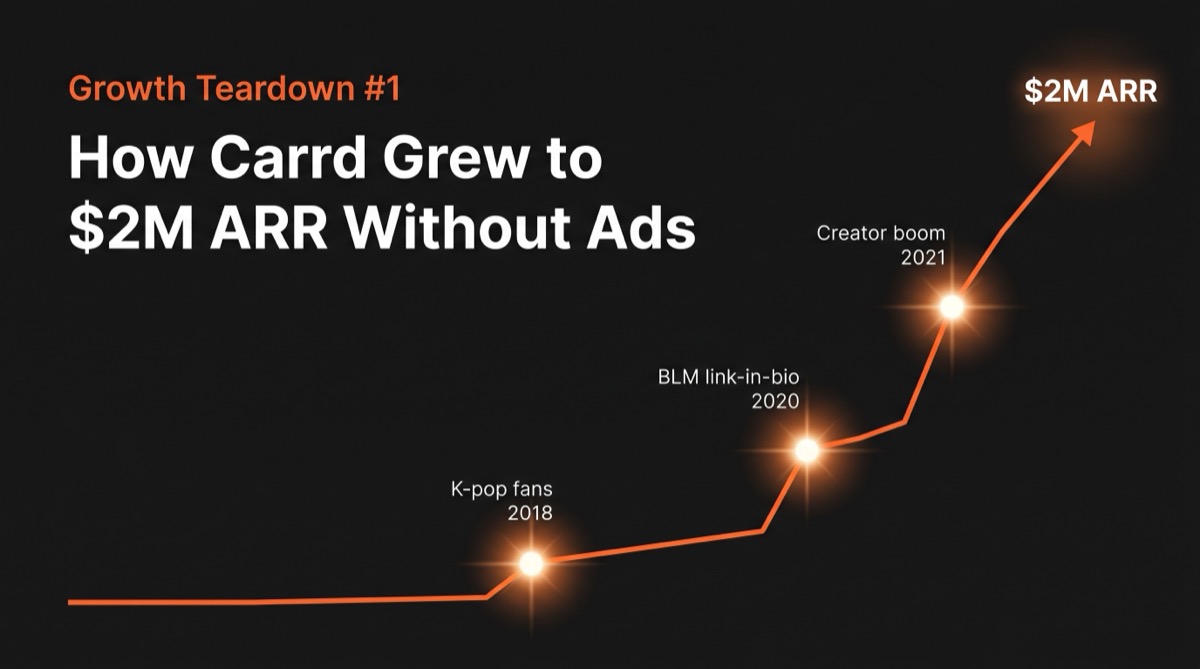
Growth Teardown #3: How Typefully Grew by Distributing on the Platform It Was Built For
Typefully built a Twitter thread drafting tool and grew it almost entirely through Twitter. The playbook: founder-led distribution, content SEO for the problem not the product, and a free tier that markets itself.
 Jordan Kennedy10 min read
Key Takeaways
- Typefully distributed a Twitter tool by being active on Twitter. The co-founders posted using their own product in front of an audience of builders and creators who had the exact same drafting problem. Every thread they published was a live product demo.
- Content marketing that teaches the audience's problem converts better than content that explains the product. Posts about Twitter growth strategy attract exactly the people who would pay for a dedicated Twitter drafting tool.
- The free tier is not a conversion funnel. It's a distribution engine. Every creator who mentions Typefully in a thread or their profile is doing marketing that paid acquisition cannot replicate.
- Launching into an established community beats launching cold. Francesco Di Lorenzo was an active member of the indie maker community before Typefully launched, which meant the first audience already trusted the founders before they had tried the product.
- The growth channels that worked for Typefully are specific to its product type. A social media tool grows on social media, through people who use social media seriously. This sounds obvious. Almost nobody executes it consistently.
In 2020, Francesco Di Lorenzo had a problem with Twitter's compose box. Not with the platform itself, but with what happened when you tried to draft a serious thread in it. You couldn't see the full thread before posting, there was no organized draft queue, and scheduling required a third-party tool designed for marketing teams rather than for people who thought carefully about what they published. He wanted something quieter and more focused: a real writing environment for people who invested in their presence on the platform.
He and his co-founder Andrea Fenn built Typefully to solve it. A dedicated environment for drafting and scheduling threads, with a clean multi-column queue, formatting that made the structure of a thread visible before it went live, and analytics that made sense for individual creators rather than for brands managing five accounts at once. They used it to write their own content on Twitter. Their audience, which was made up of other developers and indie founders paying close attention to what tools people were using, noticed.
This is the third entry in the Growth Teardown series. Carrd's growth was about a product frictionless enough to catch three accidental viral waves. Fathom's growth was about regulatory timing and a cofounder's newsletter doing the work of a sales team. Typefully is a different story: it grew by distributing on the exact platform it was built to improve, through the exact community it was built to serve, using the product itself as the marketing vehicle.
What is Typefully, exactly?
Typefully is a Twitter/X drafting and scheduling tool built around a single premise: the native compose box is not a serious writing environment for people who post regularly and care about what they publish. Its core features include a multi-column draft queue, a thread composer that shows you the full post before it goes live, scheduling with audience timing suggestions, detailed analytics for individual posts and threads, and an AI writing assistant for early drafts.
The free tier is genuinely usable. You can draft, queue, and schedule a meaningful volume of content without paying. Pro (around $19 per month) adds advanced analytics, AI features, and priority support. Team tiers handle collaboration for multi-person accounts. LinkedIn and Threads support has been added as those platforms grew, but Twitter/X remains the core product, and the design reflects that focus clearly.
Francesco and Andrea have run Typefully as a bootstrapped product from the start. No venture capital, no marketing team, no paid acquisition to speak of. Revenue comes from the subscriber base, and growth has come from channels the team participated in directly.
Why does founder-led distribution work differently than a marketing campaign?
Most products treat distribution as a separate function from the product itself. You build the thing, then you figure out how to reach people. The channels you pick (ads, content, PR, community) are external to what the product actually does.
Typefully's distribution was built in from the beginning. Francesco had spent years posting consistently on Twitter about building products, growing an indie business, and learning in public. His audience was developers, founders, and creators who were themselves invested in their Twitter presence. When he drafted and published threads using Typefully, every piece of content he wrote was simultaneously a genuine contribution to his community and a live demonstration of the product he was selling.
Not a demo video. Not a case study. The actual thing: a well-crafted thread produced by someone his audience trusted, written with a tool they could try for free by clicking his bio.
This is worth distinguishing from what most people call "content marketing." Content marketing typically involves creating material specifically designed to attract potential customers. What Typefully's co-founders did was continue doing exactly what they had always done on Twitter, posting about building products and the things they found worth sharing, but now using their own tool to do it. The distribution was baked into the work, not layered on top of it afterward.
The result: every post was a demo, every follower was a potential user, and the channel cost nothing beyond the time they were already spending.
GrowthMap
Ready to stop guessing
and start growing?
Get a personalized growth playbook built on real competitor data, live SEO metrics, and actual outreach targets. 14 sections. $29 one-time.
How does content about the problem outperform content about the product?
Typefully's content strategy targets the audience's problem, not the product's features. Posts and articles about how to write Twitter threads people actually read, how to find the right posting cadence, how to structure long-form thinking for a short-attention platform. The content is useful whether or not the reader ever signs up for anything.
This is an underused content strategy worth naming precisely: write for the person who has the problem, not for the person who knows your solution exists.
A founder searching "Typefully vs competitors" already knows the product exists and is close to a purchase decision. That search intent is valuable but limited. A creator searching "how to write a Twitter thread that gets read to the end" has the exact problem Typefully solves but may never have heard of the tool. That audience is far larger, and the content that reaches them pulls double duty: it establishes credibility on the topic, and it places the product in front of someone right at the moment they're trying to solve the thing the product helps with.
The conversion path from this kind of content is longer than a direct comparison post. But the total addressable audience is much bigger, and the traffic compounds. An article ranking for a relevant Twitter strategy query keeps pulling in readers for years after it's published, without additional work or spend.
Why did being embedded in the indie maker community matter?
There's a version of a product launch where the founders are unknown, the product is cold-starting, and every person you reach has no prior reason to trust you. That version is survivable. It's also slow and expensive, in time and energy if not in money.
Typefully's launch was not that version. Francesco and Andrea were already respected members of the Indie Hackers and maker community before the product existed. Francesco had been building in public and engaging with other makers for long enough that when Typefully appeared, it wasn't a stranger showing up with a pitch. It was someone people already knew, sharing something they'd built for a real problem they'd watched him describe publicly.
The parallel to Fathom's growth is direct. Paul Jarvis had 35,000 newsletter subscribers who trusted him before Fathom launched, and that trust converted better than any ad spend. Francesco had a Twitter community that followed his work. The mechanics differ (email versus social feed) but the principle is identical: launching into an existing relationship is categorically easier than launching cold.
This is not a shortcut you can manufacture in a few weeks. The community presence that made Typefully's launch warm was built over years of consistent participation: answering questions, sharing what he was learning, engaging honestly with other makers working on similar problems. The payoff comes at launch, but the investment starts long before the product exists.
What are Typefully's actual growth numbers?
Typefully has not published detailed revenue milestones in the manner that some other bootstrapped founders choose to, and I want to be precise about what is and is not documented publicly.
| Year | Milestone |
|---|---|
| 2020 | Tool built to solve a personal thread-drafting problem; shared with close network |
| 2021 | Public launch; growing adoption among Twitter-active founders and creators; featured in maker communities |
| 2022 | LinkedIn and Threads support added; product expands beyond Twitter-only use cases |
| 2023 | AI writing assistant features introduced; continued subscriber and creator growth |
| 2024 | Team collaboration features; meaningful scale by any bootstrapped standard |
The user base has grown to a significant number of creators and founders by observable signals: the volume of Twitter mentions, the density of discussion in maker and creator communities, and the word-of-mouth patterns visible in those spaces. Specific ARR figures have not been published publicly, and I'll leave that claim where it belongs: with the founders, when and if they choose to share it.
What is clear: Typefully is a profitable bootstrapped product running on a small team, at meaningful scale, without paid advertising, without venture capital, and without the kind of viral spike that drove Carrd's early trajectory. By those measures alone, it is worth studying.
What can solo founders learn from Typefully?
The platform you're building for is probably your most efficient distribution channel. If you are building a tool for Twitter users, the most qualified audience you can reach is on Twitter, right now, posting about the problem you solve. If you're building for developers, they're on GitHub, Hacker News, and technical communities. Most founders know this abstractly and then default to channels that feel more universally applicable (Product Hunt, startup subreddits, LinkedIn announcements) because those feel familiar. They are not more effective than being where your actual customers are.
Content for the problem compounds better than content for the product. Writing about the audience's challenge, not your solution to it, reaches people before they know they're looking for a tool. It ranks for the queries they search when they're frustrated, not the queries they search when they're comparison shopping. Both types of content matter. Problem-focused content reaches a larger upstream audience and keeps working after you stop actively promoting it.
Founder distribution is a long-term investment, not a launch tactic. The community presence that made Typefully's launch warm was not assembled in the weeks before shipping. It was years of consistent participation. The people who say "build your audience before you build your product" mean this specifically: the cost of a warm launch versus a cold one is measured in years of showing up, not weeks of pre-launch hustle.
Design the free tier around word of mouth, not just conversion. A free tier that is genuinely useful produces advocates who talk about the product. Advocates create organic word of mouth that paid acquisition cannot replicate. The question worth asking about your free tier is not "how do we move free users to paid?" but "are free users doing things they would naturally tell other people about?" If yes, you have a distribution engine running in the background.
The bottom line
Typefully's growth comes from a small set of decisions held consistently over years:
- A product built by founders who had the problem, used publicly in front of people who had the same problem
- Distribution through the platform the product was built to improve, embedded in genuine participation rather than advertising
- Content written to help the audience get better at Twitter, which pulled in qualified readers long before they were aware of the tool
- A free tier useful enough that people talked about it, turning satisfied free users into the most credible distribution channel available
- Community presence established before the product launched, so the first audience was warm rather than cold
None of these are tactics you sprint through in a launch quarter. All of them required showing up consistently, for a long time, in the community where the product's audience already lived.
If you're trying to build the equivalent flywheel for your own product, the first question is whether you're distributing in the right place or just the convenient one. That gap, between where founders default to marketing and where their customers actually are, is what GrowthMap is built to close. Paste your URL, get back the real competitor data, audience signals, and a mapped list of the specific communities, newsletters, and outreach targets where your customers spend time, before you invest months in the wrong room.
If you're earlier in the journey and need the tactical playbook for converting that audience into actual paying customers, the first 100 customers guide covers the honest version of how that actually goes.
Frequently Asked Questions
How did Typefully grow without paid advertising?
Typefully grew through three overlapping channels: the co-founders' own Twitter presence (where they used the product publicly in front of a qualified audience), content about Twitter growth strategy that attracted power users through search, and word of mouth in the indie maker and creator communities. None of these required ad spend.
Who founded Typefully?
Typefully was co-founded by Francesco Di Lorenzo (@frankdilo) and Andrea Fenn, two developers who were active in the indie maker community. Francesco's consistent public presence on Twitter, where he shared what he was building and learning, was a key part of the early distribution strategy.
Is Typefully bootstrapped?
Yes. Typefully has grown without outside investors, operating on revenue from its Pro and Team subscriber tiers. This is part of what makes it useful to study: the growth is replicable without a VC runway or a dedicated growth team.
How is Typefully's growth story different from Carrd and Fathom?
Carrd relied on three viral community waves it never planned for. Fathom relied on regulatory timing and a cofounder's newsletter audience. Typefully used a different mechanism: the founders distributing the product through genuine participation on the platform it was built for, combined with content SEO that pulled in users before they knew the product existed. Different channels, different mechanics, same bootstrapped result.
What can solo founders learn from how Typefully grew?
The biggest lesson is platform alignment: distribute where your customers are, using the medium your product was built to improve. The second is that content built around the audience's problem compounds differently than content built around the product's features. Both lessons sound straightforward. What separates Typefully is consistent execution over years, not a clever sprint.