Why Most Indie Apps Fail at Marketing (And What to Do Instead)
Five marketing mistakes that sink indie apps before they find traction, and the three-channel focus strategy that actually works for solo founders.
 Jordan Kennedy12 min read
Key Takeaways
- Shipping without an audience is the most common and most expensive mistake indie developers make. Marketing is not what you do after the product is finished. It runs in parallel from day one, and the feedback loop it creates makes the product better.
- Trying every channel at once is the same as using none of them. One channel worked for Carrd, one channel worked for Typefully, one channel worked for Nomad List. The pattern is consistency at depth, not coverage at surface level.
- Funded startup playbooks require funded startup resources. PR agencies, brand partnerships, and paid acquisition at scale all require margin and headroom that a solo founder rarely has. Borrowing tactics from a Series A company is a reliable way to burn time you don't have.
- SEO is the one marketing channel that keeps producing without daily attention once it's established. Most indie developers skip it because the results are slow. That slowness is also why it compounds and why it's worth starting early.
- Skipping customer conversations is not a time-saving strategy. Every hour you spend not talking to customers costs you multiple hours of building in the wrong direction. The founders who grow fastest talk to users constantly, not occasionally.
Most indie apps don't fail because the product was bad. They fail because nobody ever found out the product existed.
I've shipped enough products to have made most of the mistakes below myself, some of them twice. The pattern is consistent enough across indie developer communities that I'd describe it less as a series of individual errors and more as a predictable failure mode. The good news is that it's also entirely avoidable, if you can see it coming.
Why do indie developers treat marketing as an afterthought?
Because building is the part they know how to do. Writing code feels productive in a way that tweeting into the void does not. And there's a seductive logic to the sequence: finish the product, then figure out how to sell it. The product is the hard part. Marketing is just telling people about it.
That logic is wrong, and understanding why it's wrong is the first step to avoiding the failure mode it produces.
Marketing is not a megaphone you point at a finished product. It's a feedback loop that makes the product better. The developer who starts talking to potential users three months before launch arrives at launch with an audience, a list of early adopters, and real information about which features actually matter. The developer who builds in silence for eight months arrives at launch with a product that may or may not solve a problem anyone is actively experiencing.
The first mistake is therefore not really about marketing tactics at all. It's about timing.
What does "marketing from day one" actually mean?
It does not mean spending half your time on social media while the product languishes. It means running small, cheap experiments in parallel with building.
Tell people what you're building before it's built. Document the problem you're solving and share it in communities where people have that problem. Ask questions publicly. Read competitor reviews and reach out to the people writing them. Build an email list of interested people before you have anything to send them. When you do launch, you're sending an announcement to people who already know why the product exists and why it matters, rather than hoping the App Store algorithm discovers you.
This is how Pieter Levels built Nomad List. The initial version was a spreadsheet, posted publicly before a real product existed. The spreadsheet generated feedback, the feedback shaped the product, and by the time Levels had built something worth paying for, he had thousands of people who'd been following the development and were ready to become customers.
Why does spreading across every channel guarantee mediocre results?
Because attention is finite and most channels require consistent, sustained effort to produce results. One newsletter issue per month is not a newsletter. Posting twice per week on three platforms is not a content strategy. Showing up sporadically in six different communities is the same as showing up nowhere.
I see this constantly in the indie developer community: someone launches a product and immediately sets up accounts on every platform they can think of, writes a few posts, doesn't see traction, and concludes that content marketing doesn't work. What they've actually learned is that inconsistency doesn't work, which is a much cheaper lesson than it sounds.
How did the apps that actually grew handle this?
AJ, the developer behind Carrd, built a product that makes single-page websites and grew it primarily through Twitter and SEO. Not through every channel simultaneously. He picked a platform where his target users spent time, posted consistently about design and building, and let the SEO on the Carrd site do the compounding work in the background. The simplicity was not accidental. It was the strategy.
Typefully, the Twitter drafting and scheduling tool, grew almost entirely through Twitter itself. This is not a coincidence: the product is for people who are serious about Twitter, which means Twitter is where the potential customers spend most of their time. The founders were active on the platform, posted about building in public, and let the product's natural audience self-select through content that was genuinely useful to them. No paid acquisition, no complex multichannel strategy. One channel, done consistently.
Nomad List grew through building in public on Twitter and through the SEO produced by the site's data. Pieter Levels is extremely active on one platform and has been for years. The results speak for themselves: Nomad List generates millions in annual revenue with one person running it. The secret is not a secret. It is consistency on the right channel over a long enough timeline.
The pattern across all three of these examples is not which channel they chose. It's that they chose one, committed to it, and didn't treat the absence of immediate results as a reason to switch.
Why don't funded startup playbooks work for solo founders?
They require resources that solo founders don't have.
A startup with a Series A has a marketing budget, a team to execute across channels, and the runway to experiment for six months without seeing revenue. They can hire a PR agency to get coverage in TechCrunch. They can run paid acquisition at a loss to build the data they need to optimize. They can sponsor a podcast while simultaneously running a content team. These tactics work, and they produce results, but they require margin and headroom that most indie developers simply don't have.
The dangerous version of this mistake is not copying the paid acquisition strategy. It's copying the mindset. Thinking in terms of "launch events" and "press coverage" and "influencer partnerships" when you have no budget and no team to coordinate any of it. Spending two weeks preparing a big launch instead of doing the five small things that would actually reach paying customers.
What do the economics actually look like for a solo founder?
If your app costs $4.99 per month and you're spending $4 per click on paid acquisition, you need to convert at a high enough rate and retain customers long enough to justify that cost, and you need the volume to optimize. Most early-stage indie apps don't have conversion rate data reliable enough to make paid acquisition anything other than an expensive experiment.
The tactics that actually fit solo founder economics are the ones that don't require budget: community participation, SEO, cold outreach to people who've publicly described the problem you solve, and partnerships with newsletters or podcasts where you can reach an existing audience cheaply. These are slower. They also don't require you to raise money before you can afford to grow.
Why is SEO the channel most indie developers skip?
Because it's slow. The gap between publishing content and ranking for it can be three to six months, which is a long time to wait when you're watching your download numbers and wondering if anyone will ever find the product.
That slowness is also exactly why it's worth starting early. SEO is the only marketing channel where the work you do today keeps producing without daily attention once the compounding starts. A blog post that ranks for "budget app for freelancers" in month six continues to pull organic traffic in month twelve, and month eighteen, and beyond. Paid acquisition stops the moment you stop paying. Community presence requires ongoing participation to maintain. SEO keeps running in the background.
The secondary problem is execution. Most indie developers who "try SEO" write two or three posts with no keyword research, publish them on a domain with no existing authority, and observe (correctly) that nothing happens. This is not a failure of SEO. It's a failure of the conditions required for SEO to work: sustained effort, research-backed targeting, and enough content to build topical authority over time.
What does SEO actually require from a solo founder?
Not a dedicated content team. Not an expensive tool stack. What it requires is consistency and direction: understanding which search terms your potential customers actually use, writing content that is genuinely more useful than what currently ranks, and publishing often enough to build the site's domain authority over time.
For a more detailed breakdown of doing this without a paid tool stack, the zero-dollar marketing stack covers the specific free tools and weekly routines that make this manageable for one person. And if you're unsure which keywords your competitors are ranking for or which opportunities are worth targeting, free competitor analysis walks through how to answer those questions without an Ahrefs subscription.
The short version is this: start writing. One useful post per week, consistently, over six months, targeted at the language your potential customers actually use when they're searching for solutions to their problem. At six months you'll have 20-plus posts and compounding organic traffic. At twelve months you'll have a channel that requires maintenance rather than constant investment.
Why is skipping customer conversations the most expensive mistake?
Because every hour you spend not talking to customers costs you multiple hours of building in the wrong direction.
I made this mistake with an early product. I had hypotheses about what users needed based on forum posts and competitor reviews, and those hypotheses were partially right. But the parts that were wrong were expensive: features I built that nobody used, an onboarding flow that made sense to me but confused almost every new user, a pricing structure that felt logical based on what competitors charged but that real users described as confusing when I finally asked them.
I could have discovered all of those problems in two weeks of user interviews. Instead I discovered them six months later through churn data and the occasional frustrated support email.
What does a useful customer conversation actually look like?
Not an open-ended check-in. Not "what do you think of the app?" That produces polite, uninformative responses. A useful customer conversation is focused on a specific part of the product or funnel you're uncertain about, and the best question to ask is almost always: "Walk me through the last time you used this. What were you trying to do, and what actually happened?"
That question produces narrative. It produces the specific moment where the user got confused, or tried something that didn't work, or did something you never expected. That information is worth more than any analytics dashboard, because it tells you not just what happened but why, and what the user needed instead.
The other conversation worth having regularly is with people who didn't convert. If someone visited your landing page and didn't sign up, or signed up and never activated, or activated and churned after two weeks: those are the people who will tell you what's wrong. They're harder to reach than happy customers, but the information is irreplaceable. Finding where your potential customers actually gather is a good starting point for identifying where those conversations can happen organically.
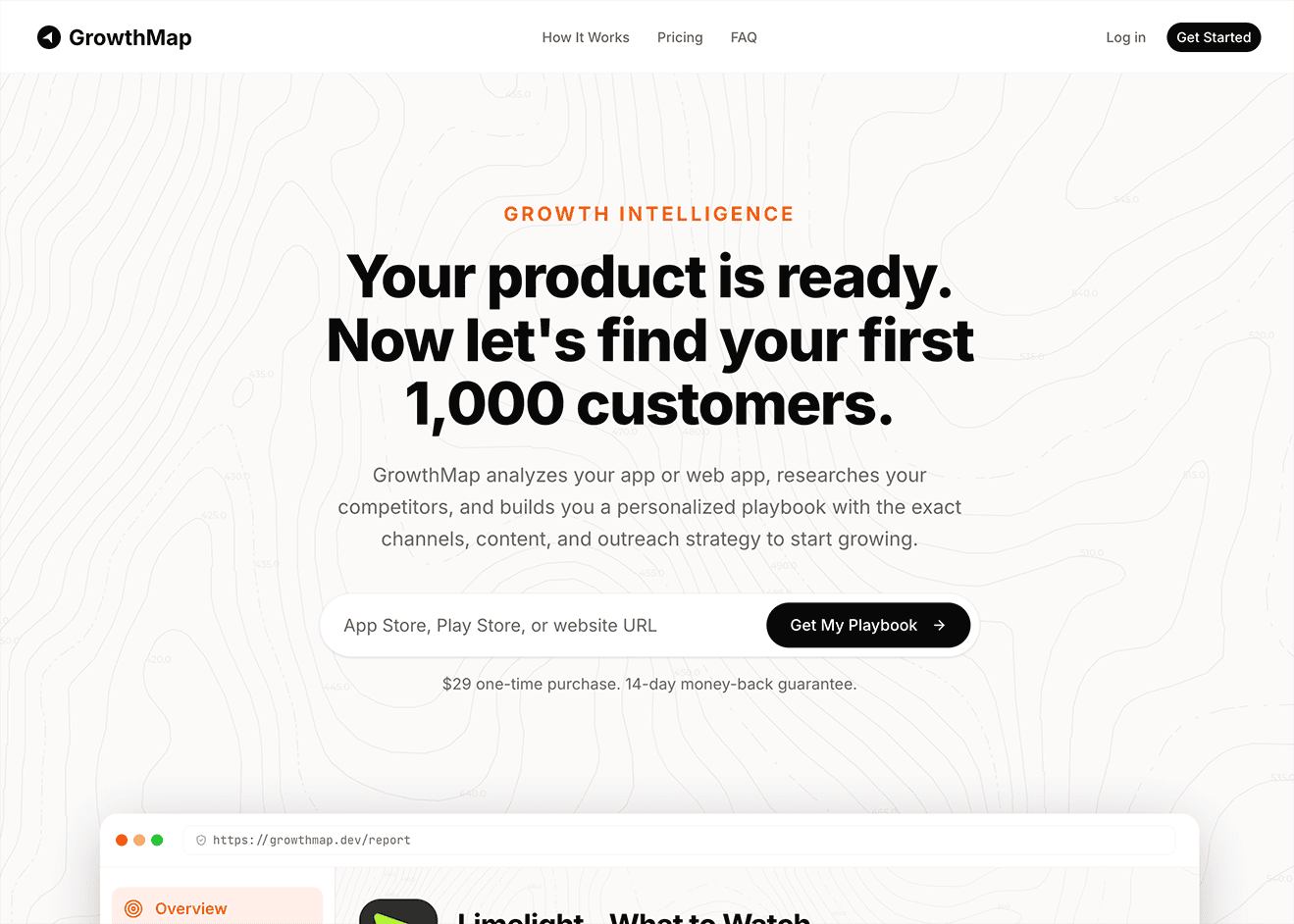
GrowthMap
Ready to stop guessing
and start growing?
Get a personalized growth playbook built on real competitor data, live SEO metrics, and actual outreach targets. 14 sections. $29 one-time.
What does a realistic three-channel focus strategy look like?
Pick one primary channel, one secondary channel, and one experimental channel. Commit to all three for 90 days before evaluating whether they're working. Don't add a fourth channel until one of the first three has produced enough to justify expanding.
The primary channel is where the bulk of your marketing time goes. For most indie developers building consumer apps, this is either the App Store (through ASO and review management), a content channel like a blog with SEO, or a social platform where your target audience is active. The choice should be driven by where your potential customers already spend time, not by which channel you personally prefer.
The secondary channel complements the primary. If your primary is SEO-focused content, your secondary might be a newsletter that distributes that content to a growing subscriber list. If your primary is community participation, your secondary might be Twitter, where you can share the useful things you're posting in communities with a broader audience.
The experimental channel is where you test something you're not yet sure about. You give it real effort for 90 days, measure what it produces, and make a decision. If it shows promise, it might graduate to secondary. If it doesn't, you stop and try something else. The key is that "experimental" does not mean "half-hearted." It means time-boxed.
Why 90 days?
Because most channels require that long to show reliable signal. A month of consistent effort tells you very little. Three months gives you enough data to distinguish a channel that needs more time from one that genuinely isn't working for your specific product and audience.
The developers I've watched grow fastest share a common pattern: they pick a small number of channels and work them with more depth and consistency than feels comfortable. They don't switch when results are slow. They switch when they've generated enough data to know the channel doesn't fit. The difference between those two decisions is usually 60 to 90 days of patience.
What actually separates the indie apps that find traction?
They solve a real problem, they tell people about it before they're done building, and they focus relentlessly on a small number of channels for long enough that results compound.
That's it. It's not a secret, and it doesn't require a budget. What it requires is discipline about where your time goes and patience with channels that don't produce overnight.
The hardest part is not understanding these principles. The hardest part is the month where you're writing blog posts that nobody is reading yet, or posting on Threads to an audience that hasn't found you, and doing it anyway because you understand what compounding looks like from the outside. The developers who get through that month are the ones who look back at month twelve and describe their growth as "overnight."
If the research side of this is where you're getting stuck, specifically figuring out which keywords to target, which communities contain your actual customers, and what your competitors are doing better than you, that's the problem I built GrowthMap to solve. It pulls real data from your product and your competitors and turns it into a specific plan rather than a list of generic suggestions. The starting point is your URL.
Frequently Asked Questions
Why do most indie apps fail at marketing?
The most common reason is prioritization: indie developers treat marketing as a post-launch activity rather than something that runs from day one. By the time the product ships, there's no audience, no distribution, and no feedback loop. The product launches cold and stays there.
How many marketing channels should an indie developer focus on?
Three: one primary channel where you invest most of your time, one secondary channel that complements the first, and one experimental channel you're testing but not committing to yet. Anything beyond three is almost certainly spreading effort across channels none of which are getting enough attention to produce results.
Why doesn't SEO work for early-stage indie apps?
It does work, but slowly. The reason most indie developers write it off is that they expect results in weeks. SEO compounds over months, and the developers who stuck with it consistently for six to twelve months consistently describe it as their highest-leverage channel. The problem is not SEO. It is expecting SEO to work on a paid-acquisition timeline.
How often should indie founders talk to their customers?
At minimum, once per week in the early stages, ideally with a specific user question in mind rather than an open-ended check-in. The most useful customer conversations are focused: pick one part of your product or funnel you're uncertain about, and spend the call understanding how real users experience it.