The Indie Dev Marketing Calendar: Hour 1, Week 1, Month 1, Year 1
Exactly what to do at every stage after launch: Hour 1, Week 1, Month 1, Year 1. A reference playbook for indie devs who want the right move, not just any move.
 Jordan Kennedy21 min read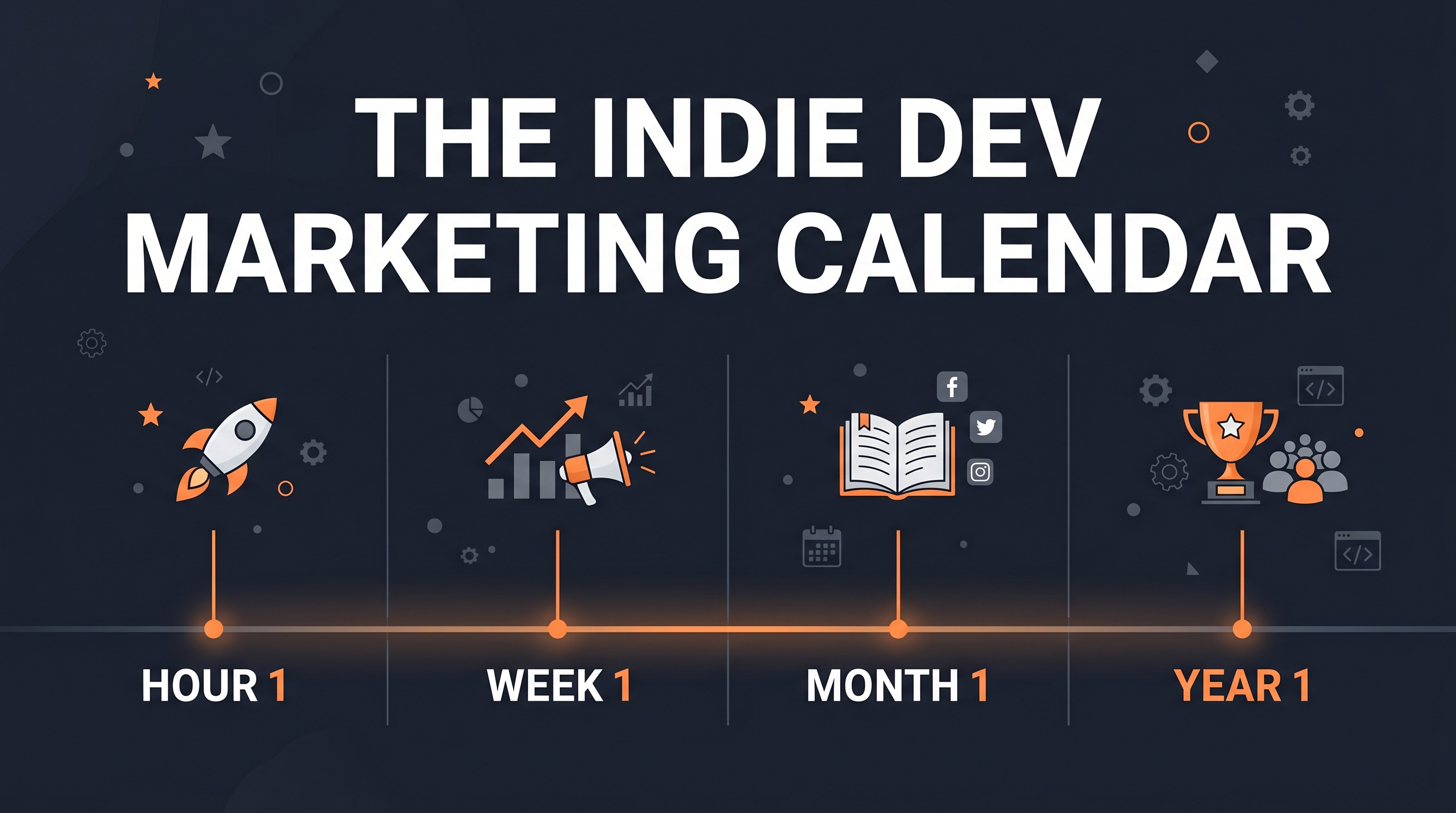
Key Takeaways
- Most indie dev marketing failures are stage mismatches: doing year 1 tactics in week 1 wastes the one moment when personal outreach has an asymmetric payoff, and doing week 1 tactics in year 1 produces noise instead of scale.
- Hour 1 is not about reach, it is about signal collection. Post in three places, DM your beta testers personally, and set up a tracking spreadsheet before you do anything else. The data you collect in hour 1 shapes everything that follows.
- Week 1 personal outreach is the highest-leverage marketing move in the entire first year. A direct message to someone who just signed up, asking what brought them there, produces customer insight no survey or analytics tool can replicate.
- Month 1's most important decision is which single channel to commit to for 30 days. Pick based on early signal, not on what you planned. Most founders pick the wrong channel and know it by week 2 but don't change course.
- Year 1 belongs to compounding channels. The indie apps that reach meaningful traction by month 12 almost always found one channel (SEO, a specific community, or a content format) that was working and did more of it rather than expanding sideways.
There is a version of marketing advice that treats every stage of a product's life the same way. Post everywhere. Be consistent. Show up every day. It sounds reasonable, and it produces nothing, because the right move in hour 1 is different from the right move in month 1, which is completely different from the right move in year 1. Applying the same tactics across all of those stages is one of the most common and least-discussed reasons indie apps stall out.
This article is structured as a reference. Find your current stage, read what to do next, and come back when you've moved to the next one. I've organized it as four distinct phases because the actions that matter are stage-specific, and confusing them is where most of the wasted effort in indie marketing comes from.
Hour 1: What to do the moment you launch
Set up analytics before you post anywhere
The first thing to do after your app or landing page goes live is not to post about it. It is to make sure you can see what happens when people arrive. If you're building a web product, PostHog's free tier handles event tracking, session recordings, and funnels. Install it in ten minutes before you do anything else. For iOS apps, App Store Connect gives you install attribution data, but you should also add PostHog or Mixpanel to the app itself so you can track what users do after they download.
The reason this comes first is that hour 1 traffic is qualitatively different from every other traffic you'll ever get. These are your most motivated early adopters, the people who showed up the moment the thing was available. Losing visibility into where they came from and what they did when they arrived is a permanent loss. You cannot reconstruct that data later.
Open a spreadsheet right now and label three columns: Source, Visitors, and Notes. You'll update this manually throughout hour 1. It sounds low-tech. It is the only way to capture sources that won't show up in analytics automatically, like someone tweeting your link or a friend sharing it in a Slack DM.
Post in three places, in this order
Hour 1 is not the time to post everywhere. It's the time to post in three specific places that reach different audiences, then stop and watch what happens.
Place one: Product Hunt. A Product Hunt launch is a structured event, not just a link submission. If you haven't prepared a proper PH launch in advance (a hunter with followers, a compelling tagline, a gallery of screenshots), do a soft submission now to claim the listing and plan a real launch for later in the week. Tuesday and Wednesday launches perform significantly better than Monday or Friday. If you are prepared, launch properly: post before 12:01 AM PT so you're in the day's queue from the start.
Place two: one relevant subreddit. Not r/startups. Not r/entrepreneur. The subreddit where the people who have the problem your product solves actually gather. If you built a budgeting app, that's r/personalfinance or r/ynab. If you built a writing tool, that's r/writing or a more specific writing community. Find the right subreddit by searching site:reddit.com [the problem you solve] on Google before you post. Read the community rules, frame your post as a thing you built rather than a product you're selling, and be honest about where it is in development. Communities forgive rough launches if the founder is genuine about it.
Place three: Hacker News Show HN or Threads. These serve different purposes. Hacker News Show HN gets you technical feedback from developers and early adopters who are specifically browsing new projects. The post format is strict: "Show HN: [one sentence description]" with a link and a brief comment from you in the first reply. Threads is faster-moving and more community-oriented. If your product targets developers or technical users, HN is the better choice. If it targets a broader consumer audience, Threads is more practical. Pick one and post.
After you've posted in all three places, stop posting and watch the spreadsheet.
DM your first 10 beta testers personally
If you had beta testers before launch, now is the time to reach out to each of them individually. Not a broadcast email, not an announcement. A personal DM or email to each person, by name, referencing something specific about their testing experience.
The message can be short: "Hey [name], the app is live now. Thank you for testing it. What's the one thing you'd most want me to fix or add in the next two weeks?" That's the whole message. You want two things from this conversation: continued engagement from someone who already knows the product, and specific feedback that tells you what to build next. Both are more valuable than any launch day metric.
If you had 10 beta testers and three of them respond with the same feature request, that is your roadmap for week 1. Write that down in your spreadsheet.
Track traffic sources from the start
Before hour 1 is over, return to your spreadsheet and log every source you can identify. PostHog will show you referrer data. App Store Connect will show you attribution channels once the first installs come in. But also note what you posted, where you posted it, and at what time. The goal is a complete picture of where your first visitors came from so that when you get to month 1 and you're deciding which channel to double down on, you have actual data rather than a guess.
The spreadsheet lives alongside your analytics tools, not as a replacement for them. Analytics tracks behavior. Your spreadsheet tracks context: the post that drove the traffic, the community where it was shared, and the note you made when you saw three people arrive from the same source within an hour of each other.
Week 1: Build the habit before the system
Reach out personally to every person who signed up
In week 1, you probably have somewhere between 10 and 200 signups. That number feels small if you're used to thinking about growth at scale. It is, in fact, the perfect number, because you can still reach out to every single one of them personally.
This is the most important thing you will do all week. Not posting. Not tweaking the landing page. Not adding analytics events. Reaching out, by name, to every person who found your product interesting enough to give you their email address.
The message is not a mass newsletter and it is not an automated onboarding sequence. It is a personal note from you, the founder, that references something specific about their situation. If your analytics show when they signed up, reference that. If they came from a specific community, reference that. Keep it to two or three sentences and end with one open question.
My default template, used loosely: "Hey [name], I noticed you signed up for [product name] [yesterday/this week]. I'm the founder, and I'm trying to understand who's finding this useful. What problem were you hoping it would solve for you?"
That question is the most important sentence you will send all month. The answers tell you who your customer actually is, what language they use to describe their problem, and what they expected the product to do. All of that feeds your positioning, your copy, and your next feature decision. An automated onboarding sequence cannot produce this. A 15-question survey cannot produce this. A personal conversation with 50 people who just signed up for something you built can.
Establish a basic posting cadence on one platform
By the end of week 1, you should be posting on one social platform three times per week. Not five platforms, not every day. One platform, three times per week, with enough consistency that you can sustain it for 12 months.
Pick the platform based on where your early signups came from, not on where you personally spend time. If your spreadsheet from hour 1 shows that several people came from Threads, post on Threads. If your Product Hunt launch drove meaningful traffic, post in the PH community. The platform where your audience already exists is always the right answer over the platform you prefer.
Three posts per week at this stage should not be polished content. They should be honest dispatches from building: what you shipped this week, what you learned from a user conversation, a specific problem you're trying to solve. This kind of content attracts the people who want to follow the journey, and those people are disproportionately likely to convert to paying customers later because they feel invested in the outcome.
Write one piece of content this week
Before week 1 ends, publish one longer piece of content. Not a product announcement, not a changelog post. Something that stands on its own: a post-mortem of building the product, a how-I-built-this technical breakdown, or a problem explainer that addresses the exact pain point your product solves.
The reason to do this in week 1 specifically is that the building process is freshest right now. The decisions you made, the dead ends you hit, and the thing you built instead are all vivid in your memory. A "how I built this" post written in week 1 is more specific and more honest than one written six months later, and specificity is what earns shares and links.
Publish it on your own site if you have a blog. Cross-post a version to Hacker News as a "Show HN" or a "Ask HN" depending on the angle. Post it in the subreddit where you launched. The same content can live in three places without feeling like spam if you frame it appropriately for each community.
Check your first organic signals
By the end of week 1, open Google Search Console and look at what queries, if any, have already started producing impressions for your site. If you're an iOS app, open App Store Connect and check your keyword impression data. These early signals are almost always too small to act on immediately, but they are directional.
If you already have 50 impressions for a keyword you didn't intentionally target, that keyword is worth noting. It means Google is associating your content or your App Store listing with that term based on what you've written. In month 1, when you're making decisions about where to put content effort, those early organic signals are the earliest version of SEO channel data you'll have.
Month 1: Commit to one channel
Pick the channel that is showing signal, not the one you planned
By the end of week 4, you need to make one decision that matters more than any other marketing decision in month 1: which single channel you're committing to for the next 30 days.
The wrong way to make this decision is to pick based on where you thought you'd grow before launch. Plans made before launch are hypotheses. The data from weeks 1 and 2 is evidence. Weight the evidence over the hypothesis.
Here is the decision framework I use. Look at your first 20 to 50 users and ask: where did the ones who seem most engaged actually come from? Not the largest source by volume, the source that produced users who came back, asked questions, and showed signs of converting. A subreddit that sent 200 people with a 0.5% conversion rate is worse signal than a specific newsletter mention that sent 40 people with a 15% conversion rate.
If three or more of your engaged early users came from the same place, that place has signal. If your organic search impressions are growing week over week even at small absolute numbers, SEO has signal. If the Threads posts that got real engagement all had a specific angle or format, content on that platform has signal. Pick whichever one of these is showing a pulse and spend month 1 working that channel seriously.
What "working it seriously" looks like in practice: publishing to that channel at least three times per week, engaging with every response or comment, and tracking what specific content formats or topics within that channel are producing the most engagement. You're not scaling month 1. You're learning the rules of one channel deeply enough to know whether it can support your growth strategy.
Establish baseline metrics before the end of month 1
Before month 1 ends, you need a set of baseline numbers that you can measure against in month 2 and beyond. The specific metrics matter less than the act of writing them down and tracking them consistently. Here are the ones worth capturing for most indie products.
Retention: Day 1 retention (the percentage of users who return the day after first use) and Day 7 retention (the percentage who return within a week). Healthy ranges for an early-stage mobile app: 40 to 60% Day 1, 20 to 30% Day 7. These are directional benchmarks, not universal targets. If your product is a utility used weekly rather than daily, adjust accordingly.
Conversion: If you have a free tier or free trial, what percentage of free users convert to paid within 30 days? A healthy range for a self-serve SaaS or app is 10 to 20%. Below 5% usually means something in the onboarding or value delivery is broken before the paywall. Above 25% usually means the free tier is too restrictive and you're leaving growth on the table.
Landing page conversion: Of visitors who arrive at your marketing site from organic sources (not paid, not direct), what percentage take a meaningful action (sign up, download, visit the pricing page)? A range of 3 to 8% from organic traffic is healthy for an early-stage product. Below 2% usually means the copy isn't landing. Above 10% is rare and worth studying.
Write these numbers down at the end of month 1 and review them again at the end of month 2. The trend matters more than the absolute number.
Do your first product iteration based on user feedback
The personal outreach you did in week 1 should have produced a set of specific user feedback by now. Before month 1 ends, ship one meaningful change based on what those users told you.
This does not have to be a major feature. It can be a confusing UI element clarified, an onboarding step made faster, or a piece of missing copy added to the settings screen. What matters is that you close the loop with the user who asked for it. "Hey, I fixed the thing you mentioned last week. Can you tell me if it feels better now?" is the kind of message that turns a free user into a paying advocate.
Get one external mention
Before month 1 ends, pitch one newsletter, one podcast, or one community moderator with a request for coverage or a guest contribution. Just one. The goal is not to go viral. The goal is to understand what the process of earning external coverage actually looks like before you need to do it at scale.
Write the pitch as a plain email, not a press release. State who you are, what you built, and specifically why it's relevant to that outlet's audience. Be concrete about the benefit to their readers: "I built a tool for freelancers managing irregular income and I've had three readers from your newsletter in my early user list" is infinitely better than "I'd love to share my story."
If you get a yes, great. If you get a no or no response, that's also useful data: it tells you that your positioning or your pitch needs work, and you have 11 more months to improve both.
GrowthMap
Ready to stop guessing
and start growing?
Get a personalized growth playbook built on real competitor data, live SEO metrics, and actual outreach targets. 14 sections. $29 one-time.
Year 1: The compounding channels
What actually separates the indie apps that make it
I want to be honest about year 1. Most indie apps don't reach meaningful traction by month 12. The ones that do share one consistent pattern: they found one channel that was working and kept doing more of it, consistently, for months, before adding anything else. Not because they were disciplined in some abstract sense, but because they learned that adding a second channel before the first one is established divides your attention without dividing the work.
The channels that compound are SEO, a specific community where you've built genuine credibility, or a content format with a consistent audience. Email lists compound too, but only once you have a reliable way to grow them. Paid acquisition can produce volume, but it doesn't compound in the same way because the results stop when the spend stops.
By month 3 or 4, you should know which of your early channel experiments produced the best ratio of time invested to users acquired. That is the channel you build around for the rest of year 1.
Build the content strategy around what worked in month 1
If month 1 showed you that your blog content was producing organic search traffic, the year 1 strategy for that channel is simple: do more of it, with better keyword targeting. Look at which posts are producing the most impressions in Google Search Console, identify the queries just beyond your current reach (positions 11 to 20 in search results), and write content specifically designed to rank for those terms.
If month 1 showed you that community participation was working, the year 1 strategy is consistency and depth. Show up in the same two or three communities every week, contribute answers to questions that don't mention your product, and let your profile link and signature do the selling. Community trust builds over six to nine months, not six to nine days, and the founders who invest in it patiently get disproportionate returns compared to the ones who post once and disappear.
For finding where those communities actually are and how to contribute without getting banned, I've written a more detailed breakdown of the research process.
Build the email list, not just social followers
At some point in year 1, you need to be growing an email list rather than just a social following. The reason is simple: you own your email list. A platform algorithm change, a ban, or a feature shift can cut your social reach overnight. An email list with 2,000 engaged subscribers produces consistent traffic and conversions regardless of what any platform decides to do.
The right time to start building the list is month 2 or 3, once you know which content is resonating. A lead magnet that delivers real value to your specific audience (a template, a checklist, a framework, a tool) converts visitors into subscribers at a far higher rate than a generic "join our newsletter" form. The lead magnet should be related to the content that's already working, because the people arriving from that content are exactly the audience you want.
The mistake I see most often here is building the list before having anything useful to send. An email list is not valuable in itself. It's valuable because you have something worth reading, week after week, that your subscribers can't get anywhere else. Build the content habit first, then build the list.
From one channel to two: how to know when you're ready
Adding a second marketing channel before the first one is genuinely working is one of the most reliable ways to produce mediocre results in both. The question isn't "when should I add a second channel?" The question is "how do I know my first channel is working well enough that I'm not just running away from it?"
The signal I use: the first channel is ready to expand when it takes fewer than three hours per week to maintain and is producing consistent, measurable results with no sign of meaningful decline. If your blog is producing organic traffic that's flat or growing and you've gotten your publishing process down to 90 minutes per post, you have capacity. If your community presence is producing a steady stream of referrals and you're spending 30 minutes a week on it, you have capacity.
When you do add a second channel, pick one that complements rather than competes with the first. SEO and email work well together because every post you publish can be shared with your list, and list subscribers are more likely to share content that then earns backlinks. Community presence and content work well together because content gives you something of value to share when community members ask questions. Avoid adding two channels that require the same kind of creative output at the same time, like starting a podcast and a YouTube channel simultaneously, because the production overhead will collapse one of them quickly.
What year 1 looks like in numbers for a healthy indie product
Specific numbers are always dangerous because they depend so heavily on product category, price point, and audience size. With that caveat: here is what a healthy year 1 looks like for a solo-built app or SaaS product in a reasonably sized market.
By month 6, you should have a clear primary channel producing consistent user acquisition, baseline metrics that are stable or improving week over week, and a small but engaged group of paying customers (somewhere between 50 and 300 is realistic depending on your price point). You should have shipped at least two meaningful product updates based on user feedback, have one external mention or piece of press, and a content archive of at least 20 to 30 posts or episodes if content is your primary channel.
By month 12, a healthy product has an email list that's a meaningful source of traffic (even if it's still small in absolute terms), a primary channel that's documented and repeatable, a conversion rate from landing page that has improved since month 1, and retention numbers that are holding at or above your month 1 baseline. Revenue is growing month over month, even if slowly.
The products that miss these targets almost always share one of two failure modes: they never committed to a single channel long enough to see compounding results, or they optimized their channel strategy without fixing a retention problem that meant they were filling a leaky bucket. If your month 7 or 8 numbers aren't moving in the right direction, the answer is usually in retention, not in distribution.
The marketing calendar is about doing the right things at the right stage
The common thread across all four stages is that the right action depends entirely on where you are. Hour 1 is about setting up visibility before anything else. Week 1 is about human conversations at a scale that's still possible. Month 1 is about committing to one channel and measuring it honestly. Year 1 is about the discipline of compounding: working what's working rather than chasing novelty.
Most of the marketing mistakes I've made and watched other indie devs make have been stage mismatches. Spending month 1 doing year 1 tactics (SEO content, cold email outreach to media) before there's even a baseline of user behavior to inform the strategy. Doing week 1 tactics in month 3 (personal DMs to every new signup, one at a time, when you now have 500 new users per week). The calendar matters because it matches the effort to the moment.
When you're in month 1 trying to figure out which channel has real signal, it helps to understand what's working for competitors in your space, what the keyword landscape actually looks like, and which outreach targets have the highest likelihood of covering you. That's exactly what a GrowthMap report is built to surface: competitive channel data, SEO opportunity analysis, and a curated list of newsletters, podcasts, and communities worth pursuing in your specific market. The data takes the guess out of the channel decision.
If you're working on the launch day itself and want a complete checklist of what to do before, during, and after, the piece on common indie app marketing mistakes covers the specific errors that cost founders the most time in the first 90 days. And if the zero-budget constraint is real, the free marketing stack I use across three apps breaks down the actual tools and weekly routine in hours.
Frequently Asked Questions
What should I do in the first hour after launching my indie app?
Set up PostHog or equivalent analytics immediately, then post in three places: Product Hunt, one relevant subreddit, and either Hacker News Show HN or Threads. Then DM your first 10 beta testers personally asking for feedback. Finally, open a spreadsheet and log every traffic source you can see. Do this before responding to comments or checking stats.
How do I do personal outreach to early users without sounding like a mass email?
Write each message by hand and reference something specific: their username, when they signed up, or the feature they used first if your analytics show it. Keep it to two sentences: what you noticed and one open question. 'I saw you signed up yesterday. What made you try it?' is better than any template.
How do I pick which marketing channel to focus on in month 1?
Look at where your first 10 to 20 users came from. If three of them found you through a specific subreddit, that channel has signal. If your landing page has a 5% or higher conversion rate from organic search, SEO has signal. Pick the channel that is already showing a pulse and spend 30 days testing it seriously before adding anything else.
What metrics should a healthy indie app be seeing after 30 days?
Rough ranges for a healthy early-stage product: 40 to 60% Day 1 retention, 20 to 30% Day 7 retention, 10 to 20% of free users converting to paid within 30 days if you have a free tier, and a landing page conversion rate of 3 to 8% from organic traffic. These are directional, not gospel. The more important signal is whether the numbers are moving week over week.
When should I add a second marketing channel in year 1?
When your primary channel is producing consistent, repeatable results and you have a documented process for it that takes under three hours per week to maintain. If your SEO channel is working but you are still actively managing it every day, you do not have capacity for a second channel. Wait until the first channel is largely running on its own before you layer anything else on top.