Growth Teardown #5: How Pieter Levels Grew Nomad List to Tens of Thousands of Members by Doing Everything in Public
Nomad List grew through building in public on Twitter, a Hacker News front-page launch, radical revenue transparency, and SEO from thousands of user-contributed city pages. No ads, no investors, one person.
 Jordan Kennedy14 min read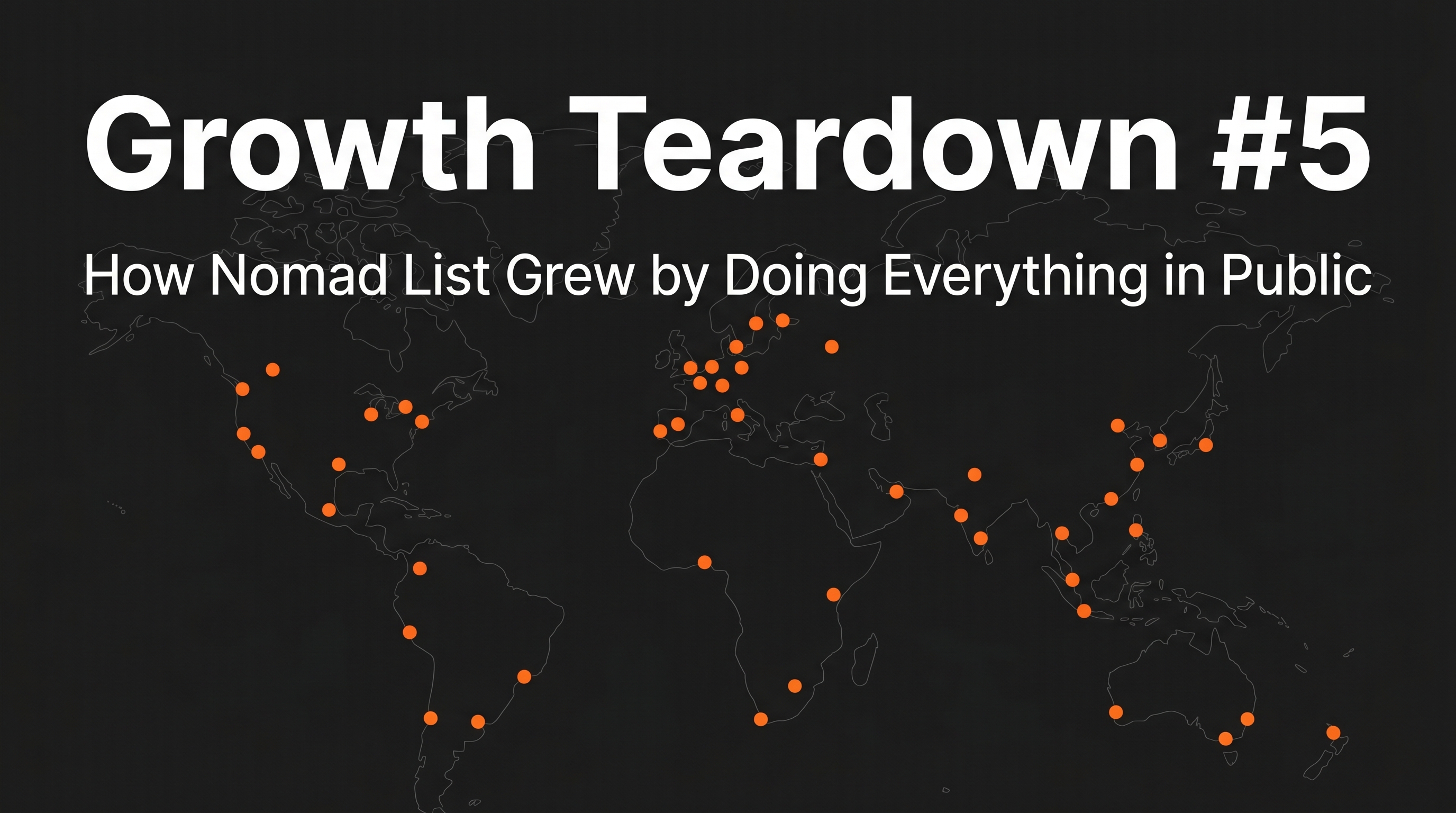
Key Takeaways
- Nomad List grew through building in public before building in public was a marketing category. Pieter Levels posted revenue figures, failures, and what he was building next on Twitter, which attracted an audience of founders and nomads who wanted to follow the work in real time.
- Revenue transparency is a form of content marketing. A tweet showing monthly revenue from a solo bootstrapped product consistently outperforms any product feature announcement, because it answers the question the audience actually wants answered: can this work without investors?
- User-contributed data is a compounding SEO asset. Nomad List's thousands of city pages grew without Pieter adding content, because the community added it. Data products where users contribute to the value are structurally different from content blogs, because the content grows with the audience.
- Hacker News is not a reliable channel for most products, but it is exceptionally good for products built for the HN audience: developers, founders, and technically-minded early adopters. Nomad List was exactly that product at exactly the right time.
- The growth channels that worked for Nomad List are deeply tied to who Pieter Levels already was on the internet before Nomad List launched. He had a developer audience on Twitter. He understood HN. He had credibility in the indie maker space. The warm launch was earned before the product existed.
In 2014, Pieter Levels was twelve months into a public challenge: ship twelve startups in twelve months, one per month, working alone. Nomad List was product number four. It started as a Google spreadsheet listing cities with columns for cost of living, internet speed, weather, and safety scores. He posted it publicly on Twitter and Hacker News in the same week, added a basic web front-end, and went back to building.
That spreadsheet became a membership business with tens of thousands of paying members, no investors, no employees, and no paid advertising. One person, a publicly available dataset, and a few distribution channels he had already earned before the product existed.
This is the fifth entry in the Growth Teardown series. Carrd's growth came from three viral waves in communities the founder never targeted. Fathom Analytics used a cofounder's newsletter audience and well-timed regulatory news. Typefully grew by distributing on the platform the product was built to improve. Finch grew through emotional product design that turned users into TikTok content creators. Nomad List is different from all four: it is the clearest case in this series of a founder whose pre-existing credibility and public presence did the work that most founders try to buy.
What is Nomad List?
Nomad List is a database of cities for digital nomads, the people who work remotely and move between locations rather than committing to a single city. Each city page aggregates data on cost of living, internet quality, safety, weather, coworking availability, and community ratings. The data is contributed and updated by the community of members, which means the coverage and depth of each page reflects the density of nomad activity in that city.
The product started as a crowdsourced spreadsheet Pieter built while living as a nomad himself. He had a personal problem: he wanted to evaluate cities quickly before deciding where to go next, and no reliable aggregated resource existed. The spreadsheet was the first version of the product, published publicly so others could add data.
From that spreadsheet, he built a web app with individual city pages, filters, a cost calculator, and a forum. The membership model charges an annual or one-time fee (originally $79/year, later $99) for access to the community forums, advanced filters, and detailed city data. The public-facing data is enough to establish the product's value. The paid tier unlocks the community, which is where the real operational value lives for someone planning to move across countries multiple times a year.
Nomad List was built under the "12 startups in 12 months" challenge Pieter had announced publicly on Twitter at the start of 2014. That challenge, which he documented openly, is part of why the audience existed to receive it.
How did Hacker News give Nomad List its first real audience?
Pieter posted a Show HN to Hacker News when Nomad List was still a basic spreadsheet-turned-web-page. It hit the front page. The discussion thread filled with exactly the right people: developers who worked remotely, founders running small bootstrapped businesses, and technically-minded nomads who had the same problem Pieter had built the tool to solve.
Hacker News front-page traffic is real and qualified in a way that most traffic sources are not. The HN audience skews heavily toward developers, founders, and early adopters who are both willing to try nascent products and willing to pay for useful tools. For most consumer apps, HN is the wrong channel: the audience is too technical, too skeptical of consumer software, and not representative of the broader population. For Nomad List, which was built for exactly that audience, it was close to perfect.
This is the mechanics of a good HN launch: the product fits the audience, the problem is specific and immediately legible to the people reading, and the founder posting is credible enough to generate discussion rather than dismissal. Pieter had been posting on HN and Twitter as a developer for years before this. He was not a stranger dropping a pitch. He was a familiar face in the community sharing something he had built for himself.
The practical implication for founders is worth stating directly: Hacker News is not a repeatable launch channel for most products, and treating it as one leads to disappointment. What it is, reliably, is an exceptional distribution surface for products built specifically for the developer and founder audience that uses it. If your product is not for that audience, a front-page HN post is a poor fit even when you get it. The people who upvote are not your buyers.
Why does building in public work as a distribution strategy?
By 2014, Pieter already had an audience on Twitter made up of developers, makers, and founders who followed his work because he had been building and posting publicly for years. When Nomad List launched, he had people to launch to. That distinction, between launching to a warm audience and launching cold, is not a minor tactical difference. It is the difference between a product that reaches early adopters immediately and one that starts from zero visibility.
The building-in-public mechanic that Pieter is most associated with is revenue transparency. He posted his MRR figures publicly and consistently, often in simple tweet format: a number, a product name, "solo, no investors, no employees." Those posts went viral repeatedly, and for a straightforward reason. They answered a question that a substantial audience of indie founders was actively trying to answer for themselves: is it actually possible to build a bootstrapped internet product that generates real revenue, alone, without raising money?
Revenue transparency is a form of content marketing, but it works differently from articles or tutorials. It is not teaching something. It is demonstrating something, specifically, that a thing most people treat as unlikely is happening in public, with verifiable numbers, from a person they can follow and watch. The audience that engages with those posts is not consuming information about growth strategy. They are checking in on the progress of something they want to believe is possible. That emotional relationship with the audience is not manufactured. It requires actually having real numbers to share.
This is the part that gets lost when founders try to replicate building in public as a tactic. The Pieter Levels playbook works because the transparency is genuine. The failures get posted alongside the wins. The next project gets announced before it is built. The revenue figures are real. When founders post "building in public" content that is selectively edited to show only progress and no friction, the audience reads it as marketing, because it is. The engagement is fundamentally different from what happens when the content is genuinely unfiltered.
The structural advantage of a founder's public presence on Twitter, specifically for an indie product, is that the audience compounds over time in a way that a campaign cannot. Each product Pieter shipped added credibility to the overall narrative. By the time Nomad List went up on HN, he had not just built one thing worth following. He was running a public experiment in what one person could build, which made every individual launch carry the weight of the whole project behind it.
How did user-generated city data become an SEO engine?
Nomad List's SEO is structurally different from most content-based SEO strategies, and the difference matters for understanding what transferred to other products and what did not.
The city pages on Nomad List are not blog posts. They are data aggregations: structured fields for cost of living, internet speed, safety, quality of life, and nomad-contributed ratings. The data on each page is added and updated by community members who have lived in those cities. Pieter did not write thousands of pages of content. The community contributed the data, and the indexed pages grew as the community grew.
This created an SEO flywheel with a different compounding rate than a content blog. A blog post requires a writer and grows at the rate that writers produce posts. A user-contributed database grows at the rate that users add and update data, which in a healthy community is faster, broader, and lower-cost to maintain. The pages that ranked for queries like "Chiang Mai for digital nomads" or "best cities for remote workers cost of living" were not planned editorial content. They were structured data pages that search engines indexed and ranked because they had high information density for specific location-based queries.
The key structural condition is that users had an incentive to contribute accurate data. A nomad who had just spent three months in Medellín and wanted other nomads to know the real cost of living and the quality of the coworking spaces would update the Medellín page because it made the resource better for their community. That incentive does not exist for a standard content blog, where readers consume but do not contribute. Data products where the community has a reason to improve the underlying data are categorically different from publishing-based SEO.
The long-tail coverage that resulted from this is significant. Nomad List eventually had city pages for hundreds of cities, including mid-tier and emerging nomad destinations that no single writer would have known to cover. Each of those pages captured search traffic for location-specific queries that would have been invisible to a content blog focused on the top ten most popular nomad cities.
GrowthMap
Ready to stop guessing
and start growing?
Get a personalized growth playbook built on real competitor data, live SEO metrics, and actual outreach targets. 14 sections. $29 one-time.
What can solo founders actually take from this?
I want to be precise about what transfers here, because the Nomad List story is easy to misread as a universal template when it is actually quite specific in its dependencies.
What does not transfer easily:
Building in public requires an existing audience, or years of investment before the distribution payoff arrives. Pieter was not unknown when Nomad List launched. He had spent years posting consistently on Twitter, building credibility with developers and founders, running public challenges, and engaging with the community. The warm audience that received Nomad List was not built during the Nomad List launch. It predated the product. A founder who starts building in public when they start their first product will get the compound growth, but not until years in, and not in time to rescue a failing launch.
Hacker News is not a repeatable channel you can plan around. The Nomad List HN post worked because the timing, the product, the audience fit, and the credibility all aligned at once. Founders who study this story and conclude "I should launch on HN" are right that HN can be a channel. They are wrong if they conclude it is a reliable one. Front-page HN placement is competitive, and many strong products never get there. Plan for HN as a potential upside, not as the primary distribution strategy.
User-generated SEO only works for products where users have a structural reason to contribute data. Nomad List's city pages grew because nomads had firsthand knowledge of cities and cared about the community having accurate information. This mechanic does not apply to most SaaS products, mobile utilities, or developer tools. If your product does not naturally produce user-contributed data, the Nomad List SEO approach is not available to you. The pages need a structural reason to grow without the founder adding content manually.
What does transfer:
Revenue transparency is worth doing even at small scale. A tweet posting your MRR, even at $1,000 or $3,000 per month, communicates something that a feature announcement never can. It tells the watching audience that this is real, that the numbers exist, that someone is making money doing the thing they want to believe is possible. The engagement on those posts consistently outperforms product content, not because the number is impressive but because the honesty is. Most founders hide their revenue when it feels small and only post it when it feels worth bragging about. The opposite approach, posting the number at every stage, is what builds the audience that makes the next launch easier.
The habit of sharing process rather than product. The distinction Pieter made that mattered most was not between good and bad marketing copy. It was between showing the work in progress and announcing finished things. An audience that follows work in progress is engaged differently than an audience that receives announcements. They are invested in the outcome. They are more likely to try the product, to share it, and to pay for it when it is ready, because they feel like participants rather than recipients. This is a habit any founder can start, regardless of audience size, and it compounds from wherever you begin.
Exploiting the channel that matches your product's audience. The HN launch worked for Nomad List because Nomad List was built for the HN audience. The Twitter presence worked because Pieter's Twitter audience was exactly the group who cared about indie founder growth stories. Every channel in this story was one where the product's natural audience was already present. The transferable lesson is to resist the pull toward channels that feel universally applicable (Product Hunt, startup subreddits, LinkedIn announcements) and instead go deeply into the specific places where the people who would pay for your product actually spend their time.
How does Nomad List compare to the rest of the series?
Each teardown in this series covers a distinct growth mechanic. The comparison table makes the differences concrete.
| Product | Category | Primary Channel | Core Mechanism | What Transfers |
|---|---|---|---|---|
| Carrd | Website builder | Viral community waves | Genuine free tier with branded output; frictionless publishing; communities self-selected | Build a real free tier; visible branding on user output; scope discipline |
| Fathom Analytics | Web analytics | Newsletter + regulatory timing | Founder's existing audience; GDPR timing; news-event content | Founder distribution compounds; regulatory tailwinds are real channels |
| Typefully | Twitter drafting tool | Founder-led Twitter distribution | Founders used product publicly on the target platform; problem-focused content | Distribute where your users are; content for the problem, not the product |
| Finch | Mental health app | User-generated TikTok content | Emotional product design created a shareable personal artifact; algorithm affinity | Platform alignment; design something users feel is theirs; emotional engagement drives ratings |
| Nomad List | City database for nomads | Building in public on Twitter + HN | Pre-built audience; revenue transparency; user-contributed SEO data | Revenue transparency at any scale; share process not just product; channel-audience fit |
The pattern running through all five is consistent: the growth channel was not selected from a menu of marketing options. It was legible from the product, the founder's position, and the audience's existing behavior. Nomad List makes this pattern more explicit than any other case in the series, because the distribution assets Pieter had (the Twitter audience, the HN credibility, the understanding of the nomad community) existed before the product did. The product was built to match an audience the founder already had, not the other way around.
The bottom line
Nomad List is the purest solo founder story in this series because it removes most of the variables that complicate the others. There was no co-founder with a newsletter, no viral product mechanic, no algorithm surfacing content to strangers. There was one person who had spent years being genuinely public about what he was building, who launched a useful product into the community he was already part of, and who kept posting the real numbers afterward.
The thing that makes this hard to replicate directly is also the thing that makes it worth studying: the distribution assets that drove Nomad List's growth were earned years before the product existed. That is not a discouraging conclusion. It is an accurate one. If you are at the beginning of building a public presence, starting today is the right answer. The years pass regardless.
If you are trying to figure out which specific channels are the right fit for your product right now, GrowthMap is built to give you that picture from your product URL: real competitor data, audience signals, and the specific communities, newsletters, and outreach targets where your customers spend time. If you are still working toward your first 100 users and want the honest tactical breakdown of what that process looks like, the first 100 customers guide covers it.
The lesson from Nomad List is not that building in public is easy. It is that building in public is the kind of investment that does not show returns until it does, and then it compounds. Pieter Levels did not invent the mechanic. He executed it more consistently and more transparently than almost anyone else, and the results over time reflected that consistency directly.
Frequently Asked Questions
What is Nomad List and how does it work?
Nomad List is a database of cities for digital nomads, crowdsourced by its community. Each city page shows cost of living, internet speed, safety ratings, weather, and community reviews. Members pay for access to forums, filters, and community features. Pieter Levels built the original version in a few days in 2014 and launched it publicly while still adding data.
How did Pieter Levels grow Nomad List without paid advertising?
Through three overlapping channels: building in public on Twitter (sharing revenue, failures, and what he was building), a Hacker News front-page launch that drove initial traffic, and SEO from thousands of city pages that community members contributed data to. All three required time and credibility, not spend.
What does building in public actually mean in practice?
Sharing the real numbers, the real failures, and the real next steps publicly and consistently. For Pieter Levels it meant posting monthly revenue figures on Twitter, writing about what he was building next before it was ready, and showing the process rather than only the polished product. The audience that follows this kind of transparency is unusually engaged and converts well to paying customers.
Can solo founders replicate Nomad List's SEO approach?
If the product generates user data, yes. Nomad List's SEO worked because users contributed city data that became indexed pages. Review platforms, comparison tools, community databases, and directory products can use the same mechanic. Standard SaaS or app products with no user-generated data cannot replicate it. The content needs a structural reason to grow without the founder adding it manually.
How is Nomad List's growth different from the other teardowns in this series?
Carrd grew through accidental virality. Fathom used a newsletter and regulatory timing. Typefully used founder-led distribution on Twitter. Finch used TikTok UGC. Nomad List is the only one in this series where the founder's pre-existing credibility and audience were the primary distribution asset. It launched into a warm audience that Pieter had built before the product existed.